Handcrafted natural solid wood toys & safe non-toxic finishes
All our guides by age
Geometry and logic guide

Wooden tangram: the 7-piece puzzle, its tangram shapes and stages by age Understanding the Chinese puzzle, introducing it at the right moment and keeping it going from Reception to adulthood

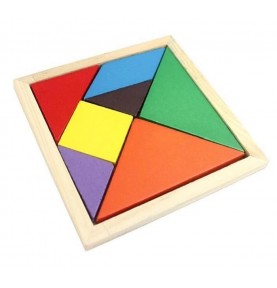
A tangram is a Chinese puzzle of seven pieces cut from a square (five triangles, one square and one parallelogram) that you arrange into tangram shapes: silhouettes of animals, people or everyday objects. The rule fits on a single line, yet the game never runs out: a four-year-old lays their first pieces on a printed outline, while an adult can still be stumped by a figure that refuses to come together. In wood, the pieces are easy to pick up, stay put on the table and stand up to years of handling.

This guide brings together everything you need to get off to a good start: how the seven pieces fit together, the right age to begin, step-by-step activities for home or the classroom, patterns sorted by difficulty, how to make a tangram yourself and what to look for when choosing a set. Teachers will also find practical ideas for Reception and Year 1 classes.

Originally from China
7 pieces, 1 square
From age 4 to adulthood
Shapes, space, logic
The basics

What is a tangram?

A tangram is a flat puzzle made up of seven pieces, known as ‘tans’, which fit together to form a square. The rule is the same for every pattern: recreate a silhouette using all seven pieces, laid flat, edge to edge, without any one of them overlapping another. No piece is left over on the table and none is added.

What makes the game so rich is the relationship between the pieces: every one of them is built from the small triangle. Two small triangles cover the square, the medium triangle or the parallelogram exactly, and one medium triangle plus two small triangles cover a large triangle. Children discover these equivalences with their hands long before they can put a name to them.

Tangram diagram: the starting square cut into seven numbered pieces 1 2 3 4 5 6 7
The starting square: 1 and 2, the large triangles; 3, the medium triangle; 4, the square; 5 and 6, the small triangles; 7, the parallelogram.

How many pieces are there in a tangram?

A classic tangram always has 7 pieces, no more and no fewer. Sets that advertise 52 pieces, or boxes of 250 wooden pattern blocks, give you many more shapes for building mosaics and larger figures: they are played differently, usually as free creation. The table below sums up where each piece sits in the square.

Piece Number Area Angles
Large triangle 2 1/4 of the square each 45°, 45° and 90°
Medium triangle 1 1/8 of the square 45°, 45° and 90°
Small triangle 2 1/16 of the square each 45°, 45° and 90°
Square 1 1/8 of the square four right angles (90°)
Parallelogram 1 1/8 of the square two of 45° and two of 135°

Every angle in the set measures 45°, 90° or 135°. That is why the pieces complement each other so well: a 45° angle placed against a 135° angle makes a straight line, and two 45° angles together make a right angle.

Where does this Chinese puzzle come from?

The tangram comes from China, where it is called qi qiao ban, ‘the seven boards of skill’. The oldest known books of figures date from the early 19th century. The game then spread to Europe and America, where it quickly became a craze; early English books simply called it the Chinese puzzle, and many people still know it as the tangram game.

The story of the servant who drops a ceramic tile, which shatters into seven pieces he can no longer put back together, is a legend. It is still a lovely way to introduce the game to a child: the character's clumsiness gives rise to hundreds of new figures.
The three rules to remember

  • 1 All seven pieces go into every figure, without exception.
  • 2 No overlapping: pieces touch along a side or at a point, never one on top of another.
  • 3 Anything goes when it comes to positioning a piece: you can rotate it or flip it over.

With younger children, it is perfectly fine to relax the first rule: a pattern of three or four pieces is an excellent way in.

What children learn

What a wooden tangram teaches your child

Behind a very simple rule, every silhouette calls on several skills at once. Wood adds real comfort to the game: the pieces have a weight and a thickness that make them easy to pick up, turn and line up edge to edge, whereas a paper cut-out slides about or bends.

Finding their way in space

Space
Rotating, flipping, orienting

To fit a triangle into a silhouette, a child first has to picture it turned a quarter turn, then check by actually rotating it. Game after game, they start to anticipate the rotation before they even move the piece.

The parallelogram adds one more challenge: it is the only piece that sometimes has to be flipped over to get its mirror image. Understanding this is often a lightbulb moment.

Words practised: on top, underneath, to the left, point upwards

Geometry they can touch

Geometry
Sides, angles, areas

By laying the pieces on top of one another, children see for themselves that two small triangles cover the square, and that one medium triangle and two small triangles cover a large one. They are handling the idea of area without a single formula.

They also learn to recognise a right angle, to tell a long side from a short one, and to name the square, the triangle and the parallelogram. These words will already feel familiar when they meet them again at school.

Five triangles, one square, one parallelogram

Searching, getting it wrong, trying again

Concentration
Built-in control of error

The tangram corrects the child without any help from an adult: if a piece is left on the table or a point sticks out of the silhouette, they can see it on their own. They try, take a piece away, turn it, try again, without ever feeling judged.

This instant check keeps the desire to search alive. A figure solved after several attempts makes them want to move on to the next one, which is a little harder.

Mistakes show up, and get fixed, right on the table

Telling stories and inventing

Language
Describing, explaining, imagining

Once the silhouette is in place, you give it a name and make up a story about it: the cat is watching a bird, the boat is setting off on a voyage. Later, the child creates their own figures and gives each one a title.

Playing in pairs means describing a piece precisely (‘the medium triangle, pointing towards the window’) or explaining how they found the answer: an excellent vocabulary exercise.

Something to talk about as much as something to build

‘The hands are the instruments of man’s intelligence.’

Maria Montessori, The Absorbent Mind

The tangram shows this idea well: children understand geometry by moving pieces around, long before they meet it again in an exercise book.

Stages by age

What age should children start the tangram?

Around the age of 4, most children enjoy copying a first pattern. The pieces are small: a tangram should never be left with a child under 3, and between 3 and 4 it is played with under an adult's eye.

How hard it feels depends less on age than on the type of pattern you offer. Here are the four stages we recommend, staying on each one for as long as your child is enjoying it. The ages are only a guide: some five-year-olds are already happy with shadows that have no inner lines, while others prefer placing pieces on the pattern until they are 6.

01 4-5 years • Reception

Tangram in Reception: educational puzzles for 4 year olds

Placing each piece on its outline: recognising shapes and matching them up

The pattern is printed at the actual size of the pieces, with the outline of each one drawn inside. The child looks for the piece that matches each shape and lays it on top, just like an inset puzzle. Start with figures of three or four pieces (a house, a boat), then move on to complete silhouettes.

  • Naming the pieces: large triangle, small triangle, square.
  • Lining up the sides without going over the outline.
  • Putting all seven pieces back in their tray at the end.
Good to know: the figure is complete when none of the printed lines can be seen any more.
02 5-6 years • Year 1

Year 1: solid silhouettes, the next step in puzzles for five year olds

Working out where the pieces meet

The pattern is still actual size, but it is now just a solid shadow: the lines between the pieces have gone. The child has to guess where each piece ends. The two large triangles make a good starting point: once they are in place, half the silhouette is already filled.

  • Place the two large triangles first.
  • Try every rotation before switching to another piece.
  • Remember to flip the parallelogram when nothing seems to fit.
Good to know: if your child gets stuck, show where one single piece goes, not the whole solution.
03 6-8 years • Years 2 and 3

Copying a smaller pattern next to the card

Comparing proportions

The pattern is now smaller than the pieces, so there is no way to build on top of it. The child builds next to the card, looks up, compares lengths and angles, and corrects. This is the age for challenge cards sorted by level, worked through at their own pace.

  • Spotting the right angles and the long straight edges in the pattern.
  • Comparing the length of the sides on the card with the pieces.
  • Keeping track of completed cards to see how far they have come.
Good to know: a stopwatch can be fun, as long as children are never compared with one another.
04 From 8 • with the family

Inventing, setting challenges, solving paradoxes

Creating their own figures

Children invent their own figures, draw round the outline and pass them on to a brother, a sister or a parent. The most curious tackle the paradoxes, such as Dudeney's two monks: two almost identical silhouettes, one with a foot and the other without, both built from the same seven pieces.

  • Keeping a notebook of their own patterns.
  • Hunting for the 13 convex shapes that can be made with the seven pieces.
  • Playing in pairs with two identical sets.
Good to know: at this age, the tangram is happily shared with grown-ups.
To do together

Tangram games and activities, step by step

Copying patterns is only one way to play. Here are five activities for home or the classroom, ranked from the simplest to the most demanding. All of them need just one set of seven pieces per child and last anywhere from ten minutes to half an hour, depending on how keen everyone is.

  1. 01 From 3, with an adult

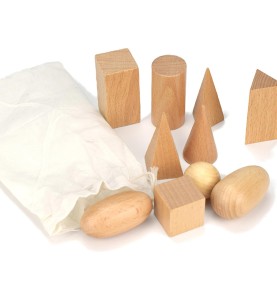
    The feely bag: a shape matching game by touch

    Aim: Recognising shapes by touch alone

    1. Slip the seven pieces into a fabric bag or a small box you cannot see into.
    2. Name a piece: ‘the square’, ‘a large triangle’. Your child feels for it with their fingers, without looking.
    3. They take it out and check for themselves whether they found the right one.
    4. Swap roles: now they do the asking and you do the searching.
  2. 02 4-5 years

    Basic combinations

    Aim: Discovering that the pieces are equivalent

    1. Hand over just the two small triangles and ask your child to make a square.
    2. With the same pieces, make a triangle, then a parallelogram.
    3. Add the medium triangle: how can they cover a large triangle?
    4. Let your child stack the pieces on top of one another to compare their areas.
  3. 03 5-6 years

    Fill in the missing pieces

    Aim: Moving from a guided pattern to working independently

    1. Build a complete figure in front of your child, on an actual-size pattern.
    2. Take two pieces away: they put them back in place.
    3. Start again, this time removing three, then four pieces.
    4. Once they can replace all seven, offer the same figure as a solid shadow.
  4. 04 From 6, in pairs

    The description game

    Aim: Describing and understanding a position in space

    1. Each player has their own set of seven pieces; an open book stands between them as a screen.
    2. The first player builds a simple figure out of sight.
    3. They describe it in words: ‘the large triangle, point down, touches the square on the left’.
    4. The second player builds from the description, then the screen comes down so you can compare.
  5. 05 From 7

    The shadow notebook

    Aim: Inventing and sharing their own patterns

    1. Your child invents a figure with all seven pieces on a sheet of white paper.
    2. They draw round the outline in pencil, remove the pieces and colour the inside with a black felt-tip pen.
    3. They give their shadow a title and keep the solution on the back of the sheet.
    4. The notebook is passed around the family or the class: everyone has a go at the others' patterns.
  6. In the classroom or in a group

    Plan one set per child: sharing seven pieces quickly leads to squabbles. In Reception, actual-size patterns with the inner lines drawn in are all you need. In Year 1, a shadow displayed on the board lets everyone search on their own before comparing the solutions they have found.

    To avoid mix-ups, give each table a set of its own colour, or mark the back of the pieces discreetly.

Figures to copy

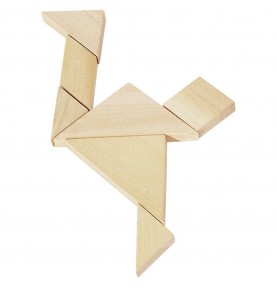
Tangram shapes: animals, people and objects

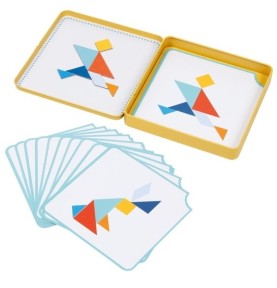
Hundreds of classic figures have been handed down since the 19th century, and anyone can invent new ones. For a child, these tangram shapes fall into three families, from the most recognisable to the most demanding. Most sets come with cards or a booklet; the patterns supplied with our classic wooden tangram with cotton bag are a good example.

Animals

Sitting cat, rabbit, fox, bird, swan, fish

Children's favourite family, because they quickly recognise what they are building. Two small triangles make the cat's ears and a large triangle its body; the parallelogram often becomes a tail or a neck. The silhouettes are compact, with large solid areas: ideal for a first go at shadows.

Best first pattern: the sitting cat

People

Walker, runner, dancer, skater, monk

Suggesting a body in motion with rigid pieces takes more careful observation. The square often serves as a head, the large triangles as a chest or a skirt, the small triangles as feet and hands. These figures are slimmer and some pieces only touch at a point, so they are best kept for Year 1 and beyond.

Best first pattern: the walking figure

Objects and buildings

House, sailing boat, bridge, arrow, letters and numbers

Straight, often symmetrical shapes that are easy to break down: the roof of a house is a large triangle, and so is the sail of a boat. These are the best patterns for the very first three- or four-piece attempts, and then for the first complete figures. Letters and numbers go down very well with children who are learning to write them.
Best first pattern: the house

What shapes can you make with a tangram?

Beyond silhouettes, the seven pieces can also build geometric shapes. Mathematicians have shown that exactly 13 convex polygons can be formed, that is, shapes with no dents at all: one triangle, six quadrilaterals (including the original square, a rectangle and a parallelogram), two pentagons and four hexagons.

For children aged 8 and over, tracking them down one by one is a fascinating challenge. Younger ones can start with shapes made from two or three pieces: a square from two small triangles, a rectangle from the square and two small triangles, a large triangle from the medium triangle and the two small ones.

Three tips for solving any pattern

1. Start with the large triangles

Between them they cover half of the area. Placing them first sketches out the body of the figure and greatly reduces the number of options for the other pieces.

2. Flip the parallelogram

When nothing seems to fit, it is often the culprit. Unlike the triangles and the square, it changes orientation when you turn it over: its hidden side gives its mirror image.

3. Look for the right angles

Spot the right-angled corners of the silhouette: a triangle or the square will often fit there. Very sharp points, on the other hand, call for a 45° angle.

Homemade

How do you make a tangram?

To try the game out, you can make a paper tangram in a quarter of an hour, with no tricky measuring at all: you simply fold and cut. A five- or six-year-old can do the folding while an adult does the cutting. Making the pieces is a fine geometry lesson in itself, because your child watches each tan emerge from the square.

  1. 1

    Cut out a perfect square

    Draw a square with sides of about 16 centimetres and cut it out. The more accurate the right angles, the better the pieces will fit together.

  2. 2

    Divide it in two

    Fold the square in half along a diagonal, point to point, then cut along the fold: you now have two large triangular halves.

  3. 3

    Make the two large triangles

    Fold the first half in two, point to point, and cut along the fold. The two large triangles are ready.

  4. 4

    Separate the medium triangle

    On the second half, fold the corner with the right angle down to the middle of the long side. Cut along the fold: the small folded-down piece is the medium triangle, and what is left is a trapezium.

  5. 5

    Cut the trapezium in half

    Fold the trapezium in half by bringing its two points together, then cut along the fold. You get two identical trapeziums, each with two right angles.

  6. 6

    Finish the last four pieces

    On each trapezium, find the middle of the long side. On the first, cut from the end of the short side opposite the right angle to that midpoint: you get a square and a small triangle. On the second, cut from the right-angled corner of the short side to that midpoint: you get a small triangle and a parallelogram.

Paper or wood: what difference it makes in use

A paper tangram is enough to try the game or to hand out to a whole class. But the corners soon get dog-eared, the pieces lift at the slightest draught and one small triangle usually ends up going missing. For a game that stays on the shelf and comes out again for years, a wooden tangram keeps its crisp edges and packs away in its tray or box. You will find ours in the tangram puzzle and wooden puzzles range.

Setting up

Setting up the tangram at home or in the classroom

Children concentrate better when everything is ready and within reach. A few simple choices are enough for the tangram to become an activity your child chooses on their own, without anyone having to suggest it.

A clearly defined surface

A tray, a plain placemat or a piece of felt: the pieces stay together and your child can see where their workspace ends. A plain, matt surface also stops the pieces from sliding about.

The pattern in full view

Place the card above the tray, facing your child, rather than off to one side: they need to see the pattern and their pieces at a single glance. A table at the right height and good light do the rest.

Patterns they choose for themselves

Sort the cards by level in a box or a folder within easy reach. Your child picks the next one when they feel ready, and puts back the one they have finished.

Tidying up that can be checked

At the end, the seven pieces go back into the tray, box or bag, counted one by one. A lost piece leaves the game incomplete: this little ritual saves a lot of searching under the sofa.

To avoid

Common mistakes that put children off

When a child loses interest in their tangram, the game itself is rarely to blame: more often it is the level of the pattern or the way the child is supported. Here are the six pitfalls we come across most often.

Starting with a shadow that has no inner lines

A solid silhouette on the very first day puts off almost every four-year-old. Begin with actual-size patterns in which each piece is drawn.

Giving away the answer too quickly

Offer a hint instead (‘what if you started with a large triangle?’) or show where one single piece goes. That way, your child keeps the satisfaction of having worked it out.

Choosing a pattern that is not to scale

To lay the pieces on the pattern, the drawing has to be exactly their size. A smaller pattern, which cannot be covered, is for older children.

Insisting on all seven pieces straight away

The seven-piece rule is the goal, not the starting point. Figures of three or four pieces are a perfectly normal stage for a four-year-old.

Turning the game into a competition

Comparing two children or hurrying them along with a stopwatch kills the urge to search. The only opponent is the silhouette.

Mixing up several sets

Put two tangram sets of different sizes in the same box and no figure will come out right any more. Keep each set complete, in its own storage.

Choosing well

How to choose a tangram set: the criteria that matter

Every tangram has the same seven pieces, but they are not all equally pleasant to play with. Before you buy, six questions will help you find the one that suits your child's age and the way they will play: on their own at home, on the move or with others.

Who is it for?

The size of the pieces

For a child of 4 or 5, large pieces are easier to pick up and line up. Pocket-sized sets suit older children, who already have the knack, and are handy for journeys.

Easy to grip?

Thickness

A thick piece is easy to pick up off the table and sits comfortably between thumb and forefinger. Too thin, and it slips under the fingers and frustrates younger children.

Where do the pieces go?

Storage

Tray, box or bag: a tangram with nowhere to live soon loses a piece. A tray has one more advantage: putting the square back together to tidy up becomes an exercise in its own right.

Where to begin?

The patterns included

Check whether the set comes with patterns, and which kind: actual size with inner lines to get started, shadows to make progress, and solutions to get unstuck. Cards sorted by level save you hunting for the right pattern.

Which look?

Colours or plain wood

Pieces in different colours help little ones tell the shapes apart and name them. A single colour makes the finished figure look more like the shadow on the pattern, which older children appreciate.

How many players?

One set or several

The tangram is a game for one. To play as a family or in class, plan one set per child, or a box that brings together several sets and patterns to build as a group.

For a first purchase, we recommend a medium-sized wooden tangram with a tray or a box, and patterns that build up gradually. A pocket-sized set can come later for days out, and the big box once your child enjoys creating their own figures.
Our selection

Our tangram sets, pattern blocks and shape games, from pocket size to the big box

Here are the games we recommend, grouped by use: discovering, taking along, progressing with cards, playing together or creating freely. The age shown is the one given on the product page, where you will also find full details of each game.

Age 3+ 7 pieces + tray
Classic wooden tangram with seven coloured pieces and their tray

Wooden Tangram Puzzle with 7 Geometric Pieces

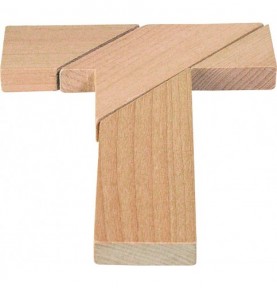
The essential tangram: seven pieces painted in different colours, which are put away by rebuilding the square in their wooden tray. Small and easy to take with you. The product page explains how to receive a file of silhouettes to copy, complete with their solutions.

For discovering the game and naming the shapes View product
Age 6+ Travel size
Wooden tangram game with its drawstring fabric bag

Classic Wooden Tangram with Cotton Bag

The seven classic tans in a cotton bag closed with a drawstring. It slips into a handbag for the train, the waiting room or the holidays, and the bag doubles as a perfect feely bag. Patterns to copy come with the game.

For playing anywhere, screen-free View product
Age 3+ 52 pieces + 16 patterns
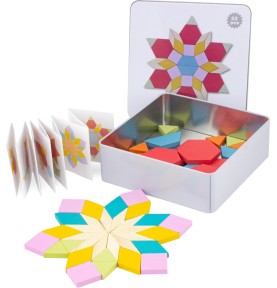
52-piece wooden tangram set with a booklet of 16 patterns

52-Piece Wooden Tangram Set

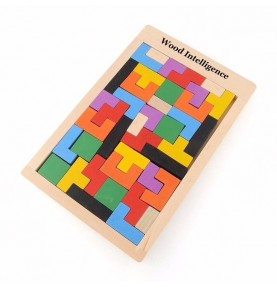
52 wooden pieces, a booklet of 16 patterns and a compact storage box. More pieces means bigger and more varied figures than with a seven-tan tangram, to build alone or with others.

For families, brothers and sisters View product
Age 3+ 250 pieces
Large box of 250 coloured wooden geometric pieces

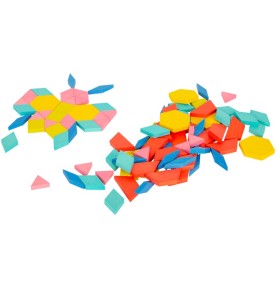
Wooden Pattern Blocks and Tangram Set, 250 Pieces

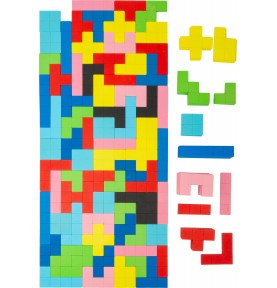
250 wooden pattern blocks in different shapes and colours, for mosaics and free creations. This is not a seven-piece tangram: it is its creative extension, for children who love putting shapes together without a set pattern.

For creating freely, on a big scale View product
Age 3+ Before the tangram
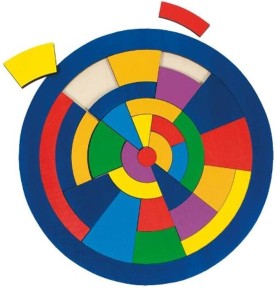
Wooden geometric puzzle with its pieces and base

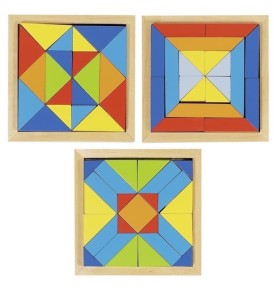
Wooden Geometric Inset Puzzle Tray

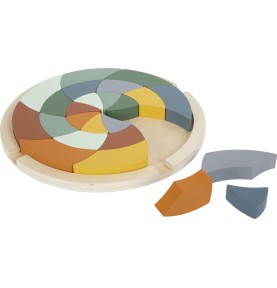
Geometric pieces to fit back into their wooden base. It looks simpler than a tangram, yet it already asks children to turn the shapes to make them fit: good preparation for those who are not quite ready for the seven tans.

For getting ready for the tangram View product
At a glance

Summary table: the right tangram at every age

For each age group: the type of pattern to offer, what your child learns from it, the matching activity from this guide and the most suitable kind of set. The ages are only a guide: let your child's enjoyment and progress lead the way.

Age Type of pattern What your child learns Suggested activity Type of set
3-4 years No pattern yet: simple shape games, with supervision Recognising a triangle and a square; turning a piece so that it fits Feely bag, geometric inset puzzle Puzzle with a base, tangram with a tray
4-5 years Actual-size pattern with inner lines, 3 to 7 pieces Naming the pieces, lining up the sides Basic combinations Tangram with a tray, large pieces
5-6 years Actual-size solid shadow, without lines Reasoning, anticipating a rotation, flipping the parallelogram Fill in the missing pieces Tangram with pattern cards or a booklet
6-8 years Smaller pattern, copied next to the card Comparing proportions, describing a position The description game Tin with cards by level, travel-size tangram
8 and over Free creation, paradoxes, convex shapes Reasoning, inventing, explaining their method The shadow notebook Travel-size tangram, 52-piece set or 250 pattern blocks
Frequently asked questions

Your questions about the tangram

The questions parents and teachers ask us most often, with short, practical answers.

What is a tangram?

A tangram is a Chinese puzzle made up of seven flat pieces, called tans, cut from a square: two large triangles, one medium triangle, two small triangles, one square and one parallelogram. The aim is to recreate a silhouette (an animal, a person, an object) using all seven pieces, laid flat, without any of them overlapping.

How many pieces are there in a tangram?

A classic tangram always has 7 pieces: 5 triangles in three sizes, 1 square and 1 parallelogram. Sets that advertise more pieces are designed for building mosaics or larger figures: they are played as free creation rather than with the seven-piece rule.

What age should children start the tangram?

Around 4, with actual-size patterns in which every piece is drawn. Around 5 or 6, children move on to solid shadows, then, between 6 and 8, to smaller patterns. Between 3 and 4, they can already handle the pieces under an adult's supervision; under 3, the pieces are too small and the game is not suitable.

How do you make your own tangram?

Cut out a square of thick paper, fold it along a diagonal and cut to get two halves. Fold and cut the first half in two: these are the large triangles. On the second half, fold the right-angled corner down to the middle of the long side and cut: this gives you the medium triangle and a trapezium. Cut the trapezium in half, then cut a small triangle from each half, together with the square from one and the parallelogram from the other.

Which tangram shapes are best for beginners?

Simple, symmetrical objects make the best first patterns: a house, a sailing boat, an arrow. Next come animals with large solid areas, such as the sitting cat or the fish. People in motion, which are slimmer, are best saved for later. With all seven pieces, you can also build 13 convex geometric shapes, a great challenge for older children.

Is the tangram used in Reception and Year 1?

Yes, it is a common classroom activity in the early years and Year 1, for learning to recognise and put shapes together. In Reception, children place the pieces on actual-size patterns with the inner lines drawn in; in Year 1, they copy solid silhouettes. Plan one complete set per child.

What should I do if my child can't copy a pattern?

First go back to an easier pattern, with the inner lines drawn in, so that they rediscover the pleasure of succeeding. On the harder pattern, give a hint rather than the solution: suggest starting with the two large triangles, or show where one single piece goes. Think about the parallelogram too: it sometimes needs flipping over.

Why do you sometimes need to flip the parallelogram?

The triangles and the square keep the same shape when you turn them over, but the parallelogram does not: flipped over, it gives its mirror image. Some silhouettes can only be completed with that side facing up. When nothing seems to fit, it is often the first piece to turn over.

Is it hard to rebuild the original square?

Yes, harder than you might think: without the tray, putting the square back together with all seven pieces often takes several attempts, even for an adult. With younger children, use the storage tray as a guide, or start with the little square made from two small triangles.

Is the tangram part of the Montessori materials?

The tangram was not designed by Maria Montessori: it comes from China and existed long before her approach. Even so, it fits very well with it, because it is hands-on, children can see their own mistakes and they progress at their own pace, from a simple pattern to a more abstract one.

How do you play tangram with several people?

Each player has their own set. You can all look for the same figure at the same time and compare solutions, set each other challenges by drawing round the outline of your own creations, or play the description game: one player describes a hidden figure, the other rebuilds it from their words. Avoid timing the youngest players.

Signature Selection

Our Wooden Educational Toys

A curated selection of durable sensory materials to support natural child development.

Signature Selection

New Arrivals & Essentials

A thoughtful selection of wholesome, durable screen-free toys to grow with independence.