Handcrafted natural solid wood toys & safe non-toxic finishes
Montessori toys by age (0 to 6 years)
Parenting guide, 24-36 months

Montessori toddler, 2 to 3 years Toys, activities and milestones from 24 to 36 months

This Montessori toddler guide is written for parents of a child aged 24 to 36 months: developmental milestones, criteria for choosing toys, an annotated selection from our catalogue and simple activities you can repeat at home. Between 2 and 3, children assert their personality with touching enthusiasm and want to do things ‘like the grown-ups’. It is the age of the famous request Maria Montessori heard from children: ‘Help me to do it by myself.’

Answering it does not mean filling the bedroom. A few well-chosen objects, real tasks (pouring, cutting, screwing, threading, tidying away) and a space organised at their height are enough to nourish their fine motor skills, their language and their independence. Each part of this guide starts from what you notice in your own child and ends with something concrete to offer. To browse all our Montessori toys for 2 year olds, the 2-3 years collection brings together everything in the catalogue for this age.

Active independence
24 to 36 months
Practical life, every day
Real, precise movements
Developmental milestones

The 3 big stages from 24 to 36 months

From the need for steady landmarks to precise everyday movements, these three stages are the common thread of the whole Montessori toddler approach: first you observe, then you offer the activity that meets the need of the moment.

01 24-30 months

The sensitive period for order

A deep need for steady, gentle landmarks

For an adult, tidying up is usually just a habit of organisation. For a toddler, outer order mirrors inner balance. Not yet aware of time passing, your child anchors themselves in the real world through places that stay the same and daily rituals that come round again. When every toy goes back to its own spot on an uncluttered shelf, they feel safe and free to throw themselves into their favourite activities. That is why, around the age of 2, tidying up together is part of the game: the puzzle goes back in its tray, the tray goes back on the shelf, and the day keeps its shape.

A dedicated place for every toy and steady routines naturally take the heat out of everyday tensions.
02 26-34 months

The language explosion and a taste for the real

Naming things with precise, respectful words

Between 2 and 3, language blossoms with joyful energy. Children take real pleasure in calling the things around them by their proper names. In the Montessori approach, we meet this thirst for understanding with precise words: ‘blue tit’, ‘jug’, ‘nut and bolt’ or ‘dustpan and brush’ rather than vague baby words. Whether they are handling vocabulary cards, a picture book or real fruit at the market, naming the world accurately helps them organise their thoughts and, little by little, put words to what they feel.

A rich, respectful vocabulary feeds their curiosity and supports their growing sense of self.
03 28-36 months

Coordinating both hands

One hand holds steady, the other works with care

During the third year, children learn to make their two hands work as a team: one holds the object firmly while the other guides the fine movement. Threading a lace through an eyelet, stringing a bead, turning a key or screwing on a lid all become absorbing challenges. These fine motor exercises loosen up the fingers, lay the distant groundwork for holding a pencil and make a child able to manage plenty of small tasks on their own.

Well-coordinated hands let them carry out the small acts of daily life on their own, and with pride.
What you will notice

Montessori toddler milestones: body, hands and language

These milestones describe what is often seen between 24 and 36 months. They are not a test: a child can be ahead with language and take their time on the stairs. Use them to choose the activity that fits right now, and talk to your health visitor or GP if anything worries you.

Whole-body movement

Running, jumping, climbing, carrying

Often observed

  • They run more and more steadily and can stop without falling over.
  • They jump on the spot with both feet together, often at around two and a half.
  • They climb the stairs placing both feet on each step, then start to alternate feet as they approach 3.
  • They want to carry heavy things: a bucket, a basket, a stool.

What you can offer

Let them carry the light shopping, step up and down a single stair, walk along a line marked on the floor. The movement games in the dedicated section carry these needs on at home.

The hands

Screwing, threading, pouring, turning

Often observed

  • They turn the pages of a book one at a time.
  • They stack a tower of six blocks or more.
  • They unscrew a lid, turn a door handle, thread large beads.
  • They hold a spoon with confidence and have a go with a fork.

What you can offer

Offer complete tasks: pouring from a small jug, cutting a wooden fruit, opening and closing boxes. Each activity should be something they can do from start to finish, tidying away included.

Language

From single words to short sentences

Often observed

  • Around 2, they often put two words together: ‘more bread’, ‘daddy gone’.
  • Their vocabulary grows very quickly from month to month.
  • Around 3, they build longer sentences and say ‘I’ and ‘me’.
  • They ask questions: ‘what’s that?’, and then ‘why?’.

What you can offer

Name objects with the right word, describe what you are doing while you cook, share picture books and stories close to their own life. Repeat their sentences back correctly without correcting them: ‘Yes, the cat is sleeping on the sofa.’

Independence and emotions

Doing it alone, choosing, standing their ground

Often observed

  • They take off their shoes, coat and trousers long before they can put them back on.
  • They want to help: laying the table, tidying up, watering the plants.
  • They say ‘no’ and ‘me do it’ with great conviction.
  • Their feelings boil over quickly when a habit changes.

What you can offer

Leave time for them to try, offer two acceptable choices rather than an open question, and keep your rituals steady. Potty training often begins during this period, at a pace that varies enormously from one child to the next.

The 30-month mark

Two and a half: what changes around 30 months

At around two and a half, many parents feel their child suddenly ‘takes off’: they talk more, their movements become more precise and they want to join in with everything. The games that kept them busy at 2 can suddenly bore them. This is not naughtiness: the challenge simply no longer matches what they can do. The three columns below help you move the shelf on without rushing the stages.

What changes

  • Sentences get longer and the questions come thick and fast.
  • Their hands become precise enough to aim for a hole, turn a lid or pick something up with tongs.
  • Pretend play takes off: they act out cooking, going to the shops, putting their doll to bed.
  • They start playing with another child, not just alongside them.

Games to offer

  • Montessori puzzles for 2 year olds: a few pieces, or blocks to turn and fit together to rebuild a picture.
  • Sorting by colour or by size with things from around the house.
  • Real little jobs: wiping the table, folding napkins, watering a plant.
  • Action songs and true-to-life stories to talk about together.

Keep for later

  • Games with rules and long turn-taking.
  • Puzzles with lots of pieces that call for a great deal of patience.
  • Toys marked ‘from 3 years’, until the birthday has actually passed.
  • Writing exercises: the hand gets ready through practical life first.

The right signal to change an activity

As long as your child repeats an activity with concentration, even for the tenth time, it is still giving them something: leave it where it is. When they succeed without thinking about it, use it for something else entirely or ignore it for several days in a row, swap it for a slightly more demanding version: a smaller jug, a puzzle with one more piece, a lace instead of a large bead.

Teaching pillars

The 3 keys to a happy, confident child between 2 and 3

Understanding the core needs of children aged 2 to 3 helps you turn everyday moments into opportunities for discovery, closeness and independence.

Pillar I

Why practical life matters

Taking part in the real work of the home

Maria Montessori showed how naturally toddlers are drawn to the tasks of everyday life rather than to pretend objects. Above all, a child longs to feel useful at home: wiping a table with a soft sponge, pouring water from a small jug, shelling peas or putting away their cutlery are genuine chances to learn.

Every practical life activity follows a calming cycle: get ready, do the task, tidy away. These real activities involve the whole body and have a natural control of error built in: if a drop of water lands beside the glass, the child notices it without stress and learns to mop it up calmly, in an atmosphere of mutual trust.

Children build their independence through concrete, rewarding tasks
Pillar II

Self-assertion and independence

Getting through the ‘no’ phase with simple choices

Around the age of 2, ‘no’ often rings out loud and clear. Far from being defiance or a tantrum for its own sake, this healthy, expected stage expresses a personality that is just beginning to assert itself. Your child is discovering, with great enthusiasm, that they are a person in their own right, able to feel and express their own preferences.

To get through these moments calmly without an exhausting tug of war, the Montessori approach suggests offering simple choices within a clear frame: ‘Would you like the blue jumper or the green cardigan?’, ‘Do you want to carry the bread or put out the spoons?’. Your child feels respected, listened to and proud to decide, which defuses the tension.

Offering concrete choices gives children responsibility within a reassuring frame
Pillar III

Sensory discovery and colours

The natural progression of the Montessori colour boxes

By handling pieces to slot in or to thread, children refine their fine motor skills while training their eyes. Maria Montessori designed the colour boxes to support this visual curiosity one step at a time. Between 2 and 3, you would generally stick to the first box; the next two tend to come after the third birthday:

  • Box 1 (primary colours): 6 tablets (3 pairs: red, yellow, blue) to learn to match two identical colours without being distracted by shape.
  • Box 2 (11 pairs): discovering the secondary colours (green, orange, purple) and the neutral ones (pink, brown, grey, black, white).
  • Box 3 (63 shades): 9 series of 7 gradations, from lightest to darkest, to sharpen the eye and the sense of shade.

Even before the first box, simply sorting socks or blocks by colour trains the eye. To go further, our colour recognition range brings together puzzles, lotto games and matching materials.

Sharpening the eye and the precision of movement with each new discovery
Choosing well

Best rated toys for 2 year olds: 7 criteria for choosing well

No toy suits every 2 year old. Lists of top rated toys for 2 year olds are a useful starting point, but the best toy is the one that meets the need you are noticing this particular week. These seven criteria, drawn from the Montessori toddler approach, help you sort through what is on offer, in a shop as well as in our own ranges. Before buying any new educational toys for 2 year olds, ask yourself these questions one by one.

  1. 1

    One difficulty at a time

    A good toy isolates one movement or one idea: size for the Pink Tower, colour for a sorting game, two-handed coordination for a lacing toy. If a toy mixes everything together, the child no longer knows what to focus on.

    Example: a cube puzzle trains observation of the picture, not counting.

  2. 2

    A mistake the child can see

    Maria Montessori called this the control of error: it is the material that shows what has gone wrong, not the adult. A piece that will not fit, a tower that leans, a drop on the tray is all a child needs to start again on their own.

    Example: an arch that is too big sticks out when the rainbow is rebuilt.

  3. 3

    A size made for their hands

    A jug they can hold in one hand, a spoon to their scale, a tray they can carry without tipping it: at this age, success often depends on the size of the object more than on the difficulty of the task.

    Example: a small jug half full rather than a full carafe.

  4. 4

    Real before make-believe

    Between 2 and 3, children are trying to understand the world as it is. Realistic pictures, animals drawn in their true colours and objects that look like the ones at home speak to them more than imaginary characters do.

    Example: a picture book of photographed fruit rather than a fruit with eyes.

  5. 5

    Pleasant, varied materials

    Wood, fabric, metal and ceramic differ in weight and in temperature. Varying materials feeds the sense of touch and makes every object more interesting to handle.

    Example: a wooden box, a metal spoon and a small natural-bristle brush on the same tray.

  6. 6

    The age stated by the manufacturer

    The age printed on a toy takes its safety into account: small parts, cords, magnets. A toy marked ‘from 3 years’ waits for the birthday, even if your child seems ready. Our selection gives the age for every product.

    Example: the lacing toys in our selection are marked from 3 years.

  7. 7

    Few objects, many uses

    A toy that can be played with in several ways is worth more than three toys that all do the same thing. Building blocks, the rainbow or the sliceable fruits stay with a child for several years.

    Example: the rainbow arches become a tunnel, a cradle, a paddock or a slide.

What sets the materials designed by Maria Montessori apart from Montessori-inspired toys is explained in our guide What are Montessori toys?

Our selection

Montessori toddler toys: our annotated selection

Nine products from our catalogue, chosen for the needs described above and easy to fit onto a Montessori toddler shelf: cutting, comparing, assembling, building, then lacing and dressing. They are grouped according to the age given on their product page. The first five are suitable right now; the next four are marked from 3 years and will wait for the birthday. For each one, you will find a presentation tip drawn from Montessori practice.

To offer between 2 and 3

From 2 years Practical life
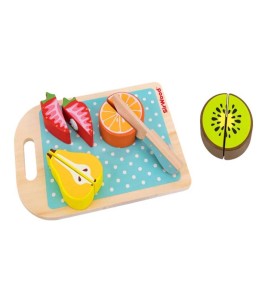
Set of wooden fruits to slice, with a wooden knife

Wooden Sliceable Fruits Play Food Set with Knife

Wooden fruits cut in half and held together with Velcro, sold with a wooden knife. Your child holds the fruit in one hand and slides the knife with the other, and the two halves come apart with a little sound that confirms the cut.

How to present it

To begin with, let them pull the halves apart and put them back together by hand, then bring in the knife. Name each fruit as it is cut: the vocabulary follows the movement.

From 18 months Sensorial
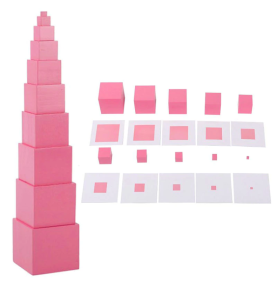
Montessori Pink Tower of ten wooden cubes with cards

The Montessori Pink Tower with 10 Visual Cards

Ten pink cubes in decreasing sizes to stack from the largest to the smallest, with picture cards. Your child compares sizes by eye and by hand: a cube in the wrong place sticks out or makes the tower lean, and they can see it for themselves.

How to present it

Start with three cubes that are very different in size, then add the others over the following weeks. The smallest cube is tiny: stay next to your child while they play.

From 2 years Observation
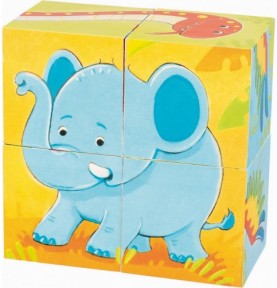
Puzzle of four wooden cubes showing wild animals

Wild Animals 4-Block Wooden Cube Puzzle

Four wooden cubes to turn and push together to rebuild a picture of an animal. Your child compares the pieces of the picture, rotates each cube and checks for themselves whether the drawing is right.

How to present it

Show the complete picture first, then separate just two cubes. All four together can come once they find the first two without hesitating.

From 2 years Free play
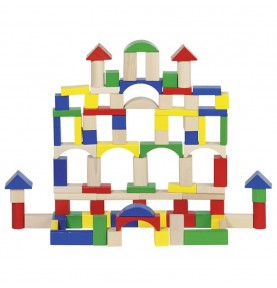
Set of 100 colourful geometric wooden building blocks

Solid Wood Building Blocks Set - 100 Classic Shapes

A hundred wooden blocks in geometric shapes and assorted colours for building towers, bridges or animal pens. Every collapse teaches your child something about balance, without an adult needing to explain.

How to present it

Put out only twenty or so pieces at a time in a basket: your child builds better and tidying up stays within reach. Change the selection when they lose interest.

From 1 year Open-ended play
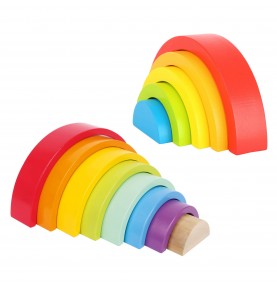
Montessori wooden rainbow with stacking arches

Montessori Wooden Rainbow Stacker

Wooden arches that nest inside one another, in three sizes: 5 pieces, 8 pieces with a ball, or 12 pieces with two balls. At 2, your child rebuilds the rainbow, lines the arches up, turns them into a tunnel for toy cars or a cradle for a little figure.

How to present it

Let them invent: the rainbow has no instructions. To choose the size or compare materials, a dedicated guide can help.

Montessori rainbow: wood or plastic? Our comparison

To keep for their third birthday

These toys follow straight on from the activities of the third year. Their product pages mark them from 3 years: that is the age to respect, even if your child shows an interest sooner.

From 3 years Lacing
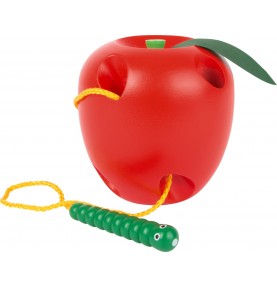
Caterpillar eating an apple, wooden lacing game

Wooden Apple Threading Toy - Caterpillar Lacing Game

A wooden apple with holes through which your child threads a little caterpillar attached to a cord. One hand holds the apple, the other guides the caterpillar: two-handed coordination in action.

How to present it

Show how to go from one hole to the next, slowly and without talking, then hand them the apple. They will find their own way through.

From 3 years Dressing
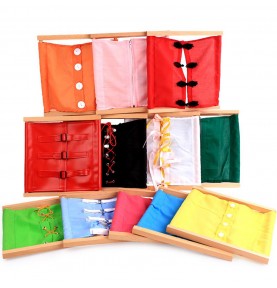
Montessori wooden dressing frame, 25 x 25 cm

Montessori Dressing Frame

A 25 x 25 cm wooden frame with a real clothing fastening to practise on flat, your choice of: large buttons, small buttons, poppers, Velcro, zip, buckle or hook. On the table, without having to hold the garment on their own body, the movement becomes much easier.

How to present it

Start with Velcro or large buttons. Small buttons and the buckle can follow, often just before starting nursery or pre-school.

From 3 years Fine motor skills
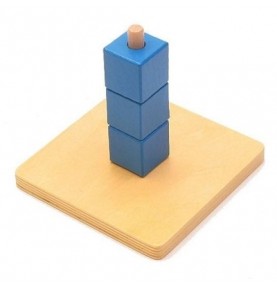
Blue cubes to thread onto a vertical wooden dowel

Montessori Vertical Dowel & Chunky Wooden Cubes

Three blue cubes to thread onto a dowel set into a square base. Aim for the hole, line the cube up, let it slide down: a short exercise that calls for precision and calm.

How to present it

Offer it on a tray, at the table. Once they manage it effortlessly, place the base a little further away so they have to stretch out their arm.

From 3 years Tongs and colours
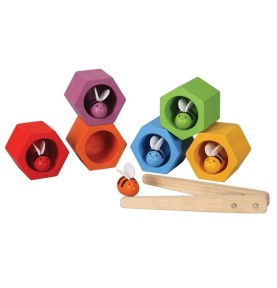
Montessori wooden beehive with tongs and coloured bees

Montessori Wooden Beehive & Colour Matching Bees Toy

A wooden beehive and a pair of tongs for picking up the bees and matching each one to the same colour. Your child works on the pincer grip of their fingers while comparing colours.

How to present it

If the tongs are tricky at first, let them place the bees by hand: matching the colours comes before mastering the tool.

Teaching tip: show the movement gently and simply

When you introduce a lacing toy or a fastening to your child, break the movement down slowly, without long explanations. Toddlers learn first by watching: carry out the movement calmly and in silence (thread the lace, let go, take it with the other hand, pull gently). Once you have shown it, simply invite your child to have a go, without expecting a perfect result.

Step-by-step activities

Indoor activities for 2 year olds: 6 easy ideas at home

There is no need to buy anything to get started: the kitchen, the laundry basket and the balcony or garden already hold plenty to keep a 2 year old busy with useful tasks. Each activity below follows the same cycle as Montessori toddler materials: get ready, do the task, tidy away. Show it once, slowly, then let your child repeat it as many times as they like.

1.Washing vegetables in a bowl

10 to 15 minutes

You will need: A washing-up bowl with a little water in the bottom, a small brush, two or three potatoes or carrots, a tea towel.

  1. 1 Set the bowl on a towel at their height and show how to scrub a vegetable under the water.
  2. 2 Let them brush each vegetable, then lay it on the tea towel.
  3. 3 Finish together: tip out the water, hang up the tea towel, put the brush away.

Two-handed coordination, the pleasure of water and the pride of having helped prepare the meal.

2.Laying the table with a drawn placemat

5 minutes, at every meal

You will need: A placemat on which you draw the outline of the plate, the glass and the cutlery with a marker pen.

  1. 1 Show once how to put each object on its outline.
  2. 2 Keep their tableware in a low drawer so they can fetch it themselves.
  3. 3 When they no longer make mistakes, take the drawing away: the place of each object has been memorised.

Order, visual memory and the feeling of being useful to the whole family.

3.Pairing socks from the laundry

10 minutes

You will need: A basket of clean socks, ideally in clearly different colours.

  1. 1 Take out three pairs that are very easy to tell apart and put one sock from each in front of them.
  2. 2 Ask them to find ‘the same one’ in the basket.
  3. 3 Add more pairs over the weeks, then socks that are closer in colour.

Matching pairs, colour vocabulary and a real part in running the household.

4.Opening and closing boxes

10 minutes

You will need: A homemade version of the Montessori lock box: a basket of four or five containers, such as a jar with a screw-top lid, a hinged box, a coin purse with a popper and a small pencil case with a zip. Inside each one, an object large enough not to go in the mouth.

  1. 1 Open one container in front of them, slowly, and reveal the hidden object.
  2. 2 Let them explore the others on their own, at their own pace.
  3. 3 To finish, they close each box before putting it back in the basket.

Wrist rotation, the pincer grip of the fingers and persistence in the face of a stiff mechanism.

5.Watering a plant

5 minutes, every week

You will need: A small watering can, half full, and a sponge for the drips.

  1. 1 Choose together the plant they will look after.
  2. 2 Show where to pour: at the base of the plant, gently.
  3. 3 If they spill some, hand them the sponge: wiping up is part of the activity.

Control of movement, caring for a living thing and the regularity of a little weekly appointment.

6.The basket of things to name

5 to 10 minutes

You will need: Three real objects from the same family (a spoon, a whisk, a ladle) or three pieces of fruit.

  1. 1 Name each object as you show it: ‘This is a ladle.’
  2. 2 Then ask: ‘Can you show me the ladle?’
  3. 3 When they point to each one without hesitating, ask: ‘What is this?’

This three-period lesson, a Montessori classic, builds vocabulary without ever putting the child in a position to fail.

To take the basket of things to name further, a picture book with realistic illustrations takes over when the real object is not to hand.

Pouring workshop

Pouring and transferring at 2: the step-by-step progression

Transferring means moving a material from one container to another. For an adult, nothing could be more ordinary; for a 2 year old, it is a complete exercise that calls for aiming, judging how much force to use, keeping the wrist straight and stopping at the right moment. It is also a classic of Montessori toddler practical life, and one of the easiest to set up with what you already have in your kitchen cupboards. The secret lies in the progression: one step at a time, and the next only when the previous one is managed without effort.

  1. Step 1

    By hand, from one basket to another

    Set-up:
    Two baskets side by side and about ten large objects: balls, big jar lids, wooden blocks.
    The movement:
    Your child picks up each object one at a time and puts it in the other basket, working from left to right.
    Ready to move on when:
    They move every object across without missing one and without rushing.
  2. Step 2

    With a spoon or a ladle

    Set-up:
    Two identical bowls on a tray with a raised edge, a large spoon, big dried pasta shapes, then rice.
    The movement:
    They fill the spoon, carry it over the second bowl without tipping it, then empty it.
    Ready to move on when:
    They hardly lose anything on the way and pick up what falls on their own.
  3. Step 3

    Pouring from jug to jug, dry

    Set-up:
    Two small jugs on the same tray, one of them holding rice or semolina.
    The movement:
    They take hold of the handle, support the spout with the other hand if needed and pour slowly.
    Ready to move on when:
    The contents pass from one jug to the other without spilling, several times in a row.
  4. Step 4

    Pouring water, then filling a glass

    Set-up:
    A small jug of water, a glass and a sponge within reach. Add a marker line on the glass to show the level.
    The movement:
    They pour up to the line, stop, then sponge up any drips.
    Ready to move on when:
    Around 3, they pour their own drink at the table: the real goal has been reached.

A tray with a raised edge

It marks out the activity and catches whatever falls. Your child sees the grains on the tray: that is the control of error, without a word from the adult.

From left to right

Place the full container on the left and the empty one on the right. This direction of work, repeated hundreds of times, is the direction of the reading they will discover later.

Always with you

Small seeds, rice or pasta can end up in the mouth or the nose: this game is played sitting at the table, with you watching, and the materials are put away out of reach afterwards.

A popular variation towards the end of the third year: transferring water with a sponge, dipped into one bowl and squeezed out over the other. Squeezing strengthens the whole hand and children love watching the water change bowls. Like every good pouring activity, it ends with tidying up: empty, wipe, put the tray back.

Moving to learn

Movement games at 2: moving, carrying, aiming

At 2, walking is well established, but the body still has everything to learn: stopping dead, keeping its balance while carrying something, climbing without holding on. Maria Montessori observed that children of this age seek out effort and spontaneously choose the heaviest task. Rather than holding back this drive, give them chances to use it safely. If your child has only recently started walking, our guide to the top rated toys for an 18 month old covers the earlier stages.

The whole body on the move

Walking the line

Mark a long line on the floor with masking tape. They follow it barefoot, then carrying a small basket, then a glass half full of water. Balance and attention improve together.

The cushion obstacle course

Cushions, a low stool, a tunnel made of chairs: they climb, crawl, step over and get down. Change the order from one day to the next so they have to think before each part.

Carrying heavy things

A bag of potatoes, a bucket of sand, a pile of books: 2 year olds love carrying more than seems possible for their size. Give them real, reasonable loads to carry and they will be enormously proud.

Aiming and throwing

A soft ball to throw into a washing-up bowl, a football to kick between two chairs set up as a goal. Move the target further away when they hit it three times in a row.

Precise fingers

Clothes pegs

Pinch to open, place on the edge of a box, let go: a difficult movement at first, which strengthens the thumb and index finger.

Threading large pieces

Cardboard tubes or large wooden beads onto a rigid pole, then onto a cord as they get closer to 3.

Screwing and unscrewing

Plastic jars of different sizes with their lids mixed up: they have to find the right one and turn it.

Tearing and sticking

Tearing coloured paper into pieces, then pressing them onto a sheet covered with glue. A calm activity to end the day.

To take these games further with wooden materials designed for small hands, have a look at our fine motor skills toys.

A balance across the day

Alternate a time when they move a lot with a quiet time at the table. A child who has been running around the park settles more readily afterwards to a pouring activity or a puzzle; on the other hand, after a long stretch of concentration, they need to let off steam. Watching for this rhythm works better than a timetable fixed in advance.

The prepared environment

Setting up your home to build independence from 2 to 3

In the Montessori approach, the environment plays a protective role: a space that is adapted, accessible and uncluttered lets a child act alone, experiment and grow up calmly.

The learning tower in the kitchen

Joining in with daily tasks at the right height

The kitchen is a warm place of discovery for a two year old. A learning tower gives them access to the worktop on a stable platform so they can join in with everyday tasks: washing vegetables, peeling a banana or pouring in ingredients. They see what you are doing, at the same height as you, and feel a full member of the household. Always stay right next to them while they are standing in it.

Pouring trays

Practising the left-to-right movement

Set out on a natural wooden tray, two bowls and a spoon invite your child to transfer large pasta shapes, rice or water, always with you watching. Prepared in advance and stored out of reach between sessions, the tray comes back out as soon as your child asks for it. The complete progression is set out in the section on pouring and transferring.

A low, accessible shelf

Clarity in the service of independence

To nurture concentration, a Montessori toddler shelf stays uncluttered: 4 to 8 well-spaced activities, each on its own tray or in its own basket, rather than a toy box where everything gets jumbled up. Your child chooses calmly, settles down to play, then puts the material back in its place themselves.

A small table and an activity mat

A space set aside for concentration

A table and a light chair sized for their body let your child sit properly, with their feet flat on the floor. For playing on the floor, unrolling a small mat marks out a clear space where their activity is protected: nobody walks on it, nobody takes what is on it.

A hallway at their height

Dressing and undressing on their own

A low peg for their coat, a little bench to sit on and a basket for their shoes: when they come home, they put their things away without help. When it is time to go out, they find everything in the same place and start getting dressed while you get ready.

An accessible bathroom

Washing hands without having to ask

A stable step in front of the basin, a towel on a hook at their height and a small mirror let them wash their hands, brush their teeth with you and watch themselves doing it. These routines quickly become habits they are proud of.

Toy rotation: how it works

Store most of the toys in a closed cupboard and leave only a few out on the shelf. Every week or every other week, notice what is no longer being used and replace it with a toy that has been put away for a while. Keep in place whatever is still chosen every day: repetition is the sign that learning is under way. A toy that comes back after a month away is often welcomed like something new, without buying anything.

  • A practical life activityPouring, sliceable fruits, boxes to open.
  • A hands-on gamePuzzle, shape sorter, building blocks, clothes pegs.
  • Something to talk about and listen toPicture book, true-to-life story, musical instrument.
Parenting tip

How can you support your child's need for order?

A toddler who cries because someone else closed a door, because their usual plate is not in its usual spot or because a piece of clothing has been moved is not being naughty: they feel the dizziness of landmarks that have suddenly been knocked over. At 2, these rituals and this outer order are the very foundation of their inner sense of security.

1. Put things back Rather than arguing, simply rewind if you can: open the door again and gently suggest they close it themselves. Most of the time, calm returns very quickly.
2. Put feelings into words, gently Acknowledge what they feel: ‘You wanted to put your shoe here yourself. I understand. Come on, let's put it back in its place together.’
3. Keep landmarks steady Keep their toys organised in a consistent way and bedtime rituals stable: these landmarks reassure them from one day to the next.
Best avoided

Common mistakes between 2 and 3, and how to avoid them

These reflexes are very common, even among parents who know the Montessori toddler approach well, and they always come from a good place: wanting to please, to go faster, to help. Simply spotting them is often enough to change the atmosphere at home, without buying anything.

Putting all the toys out at once

Faced with a full toy box, a child flits from one thing to the next without settling on any of them, and tidying up becomes impossible for them.

Instead A few activities on view on a low shelf, the rest in the cupboard, and a regular rotation.

Doing it for them to save time

Putting their coat on or pouring their water for them mostly teaches them that the adult does it better and faster.

Instead Allow ten extra minutes in the morning and hand over part of the task: they push their arm into the sleeve, you hold the collar.

Correcting while they are trying

Interrupting a hand that is working something out breaks concentration, however good the intention.

Instead Watch in silence, then show the movement again later, at another moment, if the mistake keeps happening.

Explaining with lots of words

At 2, a child cannot listen to an explanation and watch your hands at the same time.

Instead Show slowly, in silence, exaggerating each step, and save your words for naming the objects.

Choosing a toy that is too hard or meant for older children

A toy marked from 3 years, or one that is too complex, frustrates the child and may contain small parts.

Instead Respect the stated age and take away one difficulty: fewer pieces, a bigger container, a single movement.

Favouring toys that do everything themselves

A toy that lights up and sings at every press leaves little room for the child's own action.

Instead Objects that do nothing without them: blocks, a jug, a puzzle, an instrument to tap or shake.

Saying ‘well done’ after every movement

Constant praise shifts their attention towards the adult rather than towards what they have just achieved.

Instead Describe what you see: ‘You poured the water right up to the line.’ They can measure their own progress.

At a glance

Montessori toddler summary table: from 24 to 36 months

The age bands are only a guide: follow your child rather than the calendar. If an activity does not interest them, come back to it a few weeks later.

Milestones, activities and suggested materials from 24 to 36 months
Age What you often see Activities to offer From our selection
24 to 27 months A very strong need for order, first two-word phrases, running and climbing everywhere. Tidying up together, transferring by hand, laying the table with a drawn placemat, cushion obstacle course.
27 to 30 months Handier hands: they unscrew, turn, pour. The ‘no’ grows stronger. Transferring with a spoon, opening and closing boxes, choosing between two outfits.
30 to 33 months Longer sentences, questions, pretend play, first games with another child. Pouring dry from jug to jug, pairing socks, the basket of things to name.
33 to 36 months Fine coordination of both hands; they take their clothes off and start putting them back on. Pouring water up to a line, pouring their own drink, clothes pegs, threading onto a cord.
Advice and answers

Questions from parents of 2 to 3 year olds

Short, practical answers to the questions we are asked most often about independence, choosing toys and everyday life between 24 and 36 months.

Why does my 2 year old react so strongly when their routine changes?

At this age, rituals and the order of objects are a child's essential landmarks. Because they do not yet have an abstract sense of time, they find their way through the day thanks to places that stay the same and habits that come round again. The growing sense of self around the age of 2 goes hand in hand with a great need for security: if a landmark changes or a routine is disrupted, they can feel completely lost. To soothe them, the most effective reflex is to put the situation back calmly (for example, letting them close the door themselves or put their piece of clothing back in its place) and to acknowledge their emotion in simple words.

How do I apply ‘Help me to do it by myself’ without stressful mornings?

Planning ahead and keeping things simple are a parent's best allies. For calm departures, choose two comfortable outfits with your child the evening before, easy to put on alone (trousers with an elasticated waist, shoes with Velcro straps). In the morning, hand over part of the task rather than all of it: they push their arms into the sleeves, you do up the coat. The more delicate skills, such as buttons or laces, can be explored at the weekend, during calm moments. From 3 years, a dressing frame lets them practise flat on the table, without the pressure of getting out of the door.

The Montessori dressing frame

Why choose practical life activities over simple pretend-play toys?

Children aged 2 to 3 are naturally drawn to the real world of adults. Rather than pretending with make-believe objects, they find great satisfaction in carrying out real, useful tasks: wiping a table with a sponge, pouring water from a small jug or sweeping up crumbs. In the Montessori approach, these practical life activities develop fine motor skills and attention, and give the child the joy of taking part in family life. Pretend-play toys still have their place, especially when they faithfully reproduce real movements, like wooden fruits to slice.

Practical life materials

How can I develop fine motor skills before my child picks up a pencil?

Before writing or drawing lines on a sheet of paper, a child's hand needs to become more supple and more precise. Practical life prepares the hand through concrete movements: transferring with a spoon, turning a lid to work the wrist, threading large beads, using a clothes peg to strengthen the thumb and index finger. Through these movements repeated every day, a child gains real dexterity without ever tensing up over a writing exercise that comes too early.

What to buy 2 year olds: how do I choose a toy that suits 24 to 36 months?

First watch what captivates your child: pouring, stacking, opening, naming. Then choose a toy that isolates a single difficulty, shows them their own mistakes and is the right size for their hands. Check the age stated by the manufacturer, which takes small parts into account. Finally, prefer a few open-ended toys (blocks, a rainbow, sliceable fruits) to a pile of single-purpose toys. Our section on the 7 criteria for choosing goes through each of these points in detail.

Gift ideas for 2 year olds: the whole 2-3 years range

What are good 2 year old toy ideas when you only have ten minutes?

You do not even need a toy: three activities take a minute to prepare with what you have at home. Wash two or three vegetables in a bowl with a small brush, pair up a handful of socks, or transfer large pasta shapes from one bowl to another with a spoon, sitting at the table. Show the movement once, slowly, then let them do it. Tidying up is part of the game: they empty, wipe and put the materials away with you.

The 6 step-by-step activities

How many toys should a 2 year old have within reach?

On a Montessori toddler shelf, between 4 and 8 activities are enough, each in a fixed place, on a tray or in a basket. The rest waits in the cupboard. Every week or two, replace whatever is no longer chosen with a toy that has been put away for a while, keeping what they still use every day. Less choice helps them concentrate and tidy up by themselves.

At what age can I offer a real jug, glass or knife?

From 2, many children can pour water from a small, half-full jug into a glass, with a sponge within reach. A small, thick glass or a tumbler teaches them to hold an object with care. For cutting, start with wooden fruits to slice, then a banana with a round-ended knife, always sitting at the table with you beside them. The tool should be the size of their hand, and the adult is the one who picks up anything broken.

Can a toy marked ‘from 3 years’ be given at two and a half?

No. The age stated on a toy does not measure a child's intelligence: most often it signals a risk, such as small parts, a cord or magnets. Even if your child seems ready, wait for their birthday. In the meantime, offer a version of the same movement suited to their age: large beads on a rigid pole before lacing, wooden fruits to slice before a real knife.

My child only stays on an activity for two minutes: is that normal?

Yes. Between 2 and 3, attention builds up in short bursts, and it varies a great deal with tiredness, hunger or the interest of the moment. It lengthens when the activity matches exactly what the child is trying to master. If the challenge is too great, they give up; if it is too small, they get bored. Adjust the activity rather than insisting, and avoid interrupting them when they are absorbed.

How do I prepare my child for starting nursery or pre-school around age 3?

Independence skills matter more than school learning: taking off and hanging up their coat, putting on shoes with Velcro straps, washing their hands, opening their water bottle or snack box, asking for help in words. Practise them in everyday life, without pressure. After that, toys for 3 year olds take over with early mark-making, first letters and quantities.

Our guide to Montessori toys for 3 year olds (3 to 6 years)Toys for 3 year oldsIndependence and everyday skills

First Steps & Motor Skills

Montessori Toys 1 to 3 Years

Walkers, object permanence boxes and shape sorters to develop motor independence.