Handcrafted natural solid wood toys & safe non-toxic finishes
Montessori toys by age (0 to 6 years)
Guide for 12 to 24 months

Top rated toys for 18 month old toddlers: a Montessori guide from 1 to 2 First steps, busy little hands and a strong urge to do it alone

Looking for top rated toys for 18 month old toddlers, or simply for the right toys at any point between the first and second birthday? This Montessori guide helps you choose them, set up a simple play corner and recognise what your child is trying to master during this year. In twelve months, they go from first steps holding your hand to a slightly clumsy run, from grabbing with the whole hand to a precise pincer grip between thumb and forefinger, and from babbling to their first words.

The Montessori approach needs neither expensive equipment nor a programme. It is about watching first, then offering a few well-chosen objects that match exactly the skill your child is working on right now. In this guide you will find month-by-month milestones, our criteria for choosing, an annotated selection of wooden toys, activities explained step by step and gift ideas. To browse the shop directly, our Montessori toys for 1 year old children are grouped in the 0 to 24 months section, and our sensory and discovery toys have a section of their own.

  • 12 to 24 months: from wobbly first steps to the first clumsy runs
  • One skill at a time: a single new challenge per toy
  • 6 to 8 toys on show: on a low shelf, rotated regularly
  • Wood and real objects: real weight, real textures, real sounds
In short

Montessori toys 1-2 years: the essentials in 5 points

  1. 1 Between 1 and 2, children learn above all with their bodies: walking, carrying, pushing, putting things in, taking them out, stacking.
  2. 2 A good toy offers one clear challenge and shows the mistake by itself: the shape will not go in, the tower leans.
  3. 3 A few toys at a time, set out on a low shelf and swapped every two or three weeks, are worth more than an overflowing toy box.
  4. 4 The adult shows the movement slowly, without talking while doing it, then steps back and lets the child try, even when it takes a while.
  5. 5 Every child moves at their own pace: the ages in this guide are landmarks, not tests.
Developmental milestones

What your child learns between 12 and 24 months

These ages describe a general trend: a gap of several months between two children is common, and a child who walks late can be very skilful with their hands. Use these milestones to notice what is keeping your child busy right now, not to compare them with others. If one stage worries you, your GP or health visitor is the right person to talk to.

12 - 15 months Stage 1

Standing up and letting go of your hand

Many children pull themselves up on the furniture, cruise along the sofa, then try a few steps on their own. Others have already been walking for several weeks, and others still will wait until 16 or 18 months: all of this is perfectly normal.

  • Hands: the pincer grip between thumb and forefinger lets them pick up a crumb or a small ball. Above all, they are learning to let go on purpose, which is why throwing, dropping and posting things into a box are such a joy.
  • Mind: they know that a hidden object still exists and they go looking for it. They understand simple instructions when you add a gesture.
The skill of the moment
Putting in, taking out, dropping
What to offer
A single ball box, a stacking pyramid with a few rings, a stable push along walker.
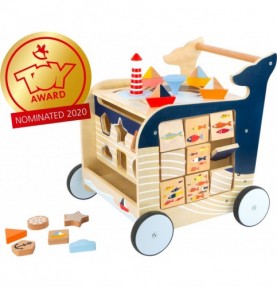
See the ‘walking, pushing, carrying’ section
15 - 18 months Stage 2

Walking while carrying something

Walking becomes steadier: your child crouches to pick something up and stands again without support, pulls a toy along behind them, climbs onto the sofa. They love moving about with their arms full, even with something far too big for them.

  • Hands: they stack two or three blocks, fit a round piece into a round hole, turn the pages of a board book (often several at once) and scribble with a chunky crayon.
  • Language: they point at what they want, say a few words and understand far more than they can say.
The skill of the moment
Fitting a shape, stacking, scribbling
What to offer
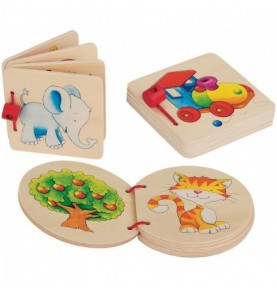
A pull along toy, a simple shape sorter, a wooden picture book, a basket to carry.
See the ‘little hands and shapes’ section
18 - 21 months Stage 3

Doing everything alone, especially what the grown-ups do

This is the ‘me do it’ age. Your child runs and falls often, climbs the stairs holding on, and copies what adults do: sweeping, wiping the table, stirring with a spoon.

  • Hands: they fit a square and a triangle by turning the piece, thread large beads onto a rigid rod, stack three or four blocks, then more. They start feeding themselves with a spoon, with plenty of mess.
  • Mind: they compare big and small, sort by colour when shown how, and concentrate for several minutes on one movement that they repeat.
The skill of the moment
Turning a piece, threading, comparing sizes
What to offer
A knob puzzle, a pounding bench, the first cubes of the Pink Tower, a small broom.
See the ‘stacking and comparing’ section
21 - 24 months Stage 4

Matching, naming and helping at home

Walking is now secure: your child kicks a ball, squats down to play and carries a tray with great care. They often put two words together (‘more cake’, ‘daddy gone’) and name what they see in books.

  • Hands: they unscrew a lid, pour seeds from one pot to another, pull off their socks and put an object back in its place once they know where that place is.
  • Mind: they match a picture to an object, wait their turn for a few seconds and enjoy small routines that come back every day.
The skill of the moment
Pouring, screwing, matching picture and object
What to offer
An activity table, a xylophone, picture books, the first practical life activities.
See the step-by-step activities
01
Gross motor skills

Walking, pushing, carrying: confident first steps

Balance and coordination

As soon as they can stand, children go looking for a challenge: lifting the laundry basket, pushing a chair across the kitchen, hauling a cushion bigger than they are. Maria Montessori spoke of ‘maximum effort’ to describe this need to measure themselves against heavy or awkward objects. It is not naughtiness: by carrying, a child learns where to put their weight, how to widen their stance and how to catch themselves.

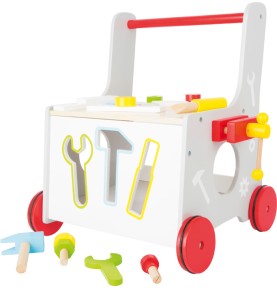
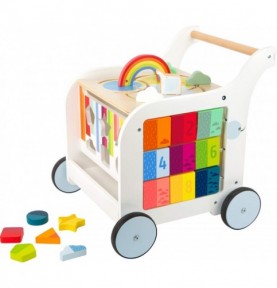
At home, this means very simple things: a small basket to carry toys from one room to another, a sturdy stool they can move around, a pull along toy on a short string. A stable Montessori push along walker with brakes supports the first steps: your child leans on it to move forward, then loads it with blocks and soft toys once walking is secure.

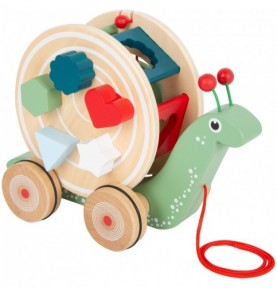
Once your child walks unaided, push and pull toys take over, and our section of push along toys for 1 year old children includes pull along toys too. Pulling a snail on wheels means walking while looking back over your shoulder, which already takes good balance. Let them walk barefoot indoors as well when the floor allows: they feel the ground better and adjust their footing.

02
Fine motor skills

Little hands: from the ball box to Montessori puzzles for 1 year old toddlers

Pincer grip, wrist rotation, letting go

Once upright, a child has both hands free, and they become far more precise as the months go by. They no longer grab only with the whole palm: they pinch between thumb and forefinger, then with three fingers. Above all, they learn to turn an object the right way before putting it down, something an adult does without thinking and which, at this age, takes real concentration.

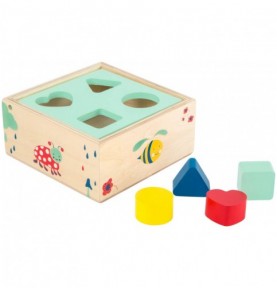
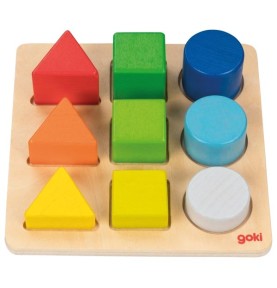
Montessori shape sorters and inset toys follow a simple principle: isolate one difficulty at a time. The single ball box only asks the child to let go in the right place. The triangle asks them to turn the piece. If the shape will not go in, the child sees it for themselves, without an adult having to say ‘no, not there’: this is what Montessori called control of error. Here is the progression we recommend.

  1. 1

    One ball, one hole

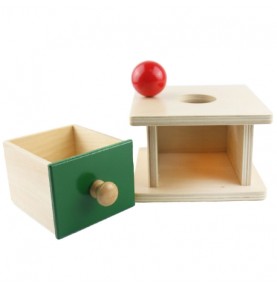
    A box with a single round hole and a drawer: the ball disappears, then comes back. There is no need to turn anything the right way, so success comes straight away.

    From 12 months
  2. 2

    The cylinder, then the cube

    A solid shape to post through a hole that matches it: now the piece has to be held upright. The cube asks the child to line up four sides.

    Around 14-18 months
  3. 3

    Several shapes, one choice

    The shape sorter or the three-shape puzzle: your child has to pick the right opening, try, get it wrong and try again.

    Around 16-20 months
  4. 4

    The triangle and the little knobs

    The points of the triangle force a twist of the wrist. Knob puzzles ask the child to grip between thumb and forefinger.
    Around 18-24 months

When your child keeps pushing on a piece that will not fit, wait a few seconds before stepping in. If they get frustrated, simply turn the box so that the right hole faces them, without doing the movement for them. And if a box with six shapes puts them off, take three of them away for a while.

03
Sizes and volumes

Stacking and comparing: from the ring pyramid to the Pink Tower

Big, small, heavy, light

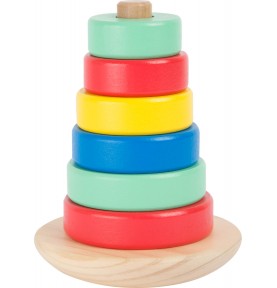
Before 18 months, stacking mostly means threading rings onto a rod or putting one block on another, then knocking everything down. The pyramid's rod guides the hand, which makes it the first stacking toy to offer. At first, your child threads the rings in any order, and that is absolutely fine. Size order will come later, when they notice that the big ring no longer fits over the small one.
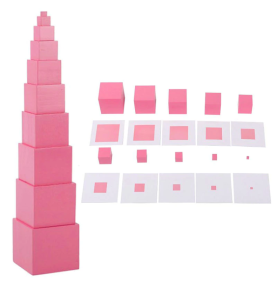
At around 18 months, the Montessori Pink Tower can join the play corner, as long as it is presented with an adult close by. Ours has ten pink cubes whose sides grow from 0.7 cm to 7 cm in regular 0.7 cm steps, with ten control cards. All the cubes are the same colour: only the size changes, so your child has just one thing to compare.

At this age, do not offer all ten cubes. Start with the three or four largest, which look clearly different, and keep the smallest out of reach: a cube of less than one centimetre has no place in a toddler's mouth. The largest cube takes two hands, the smallest just the fingertips, so carrying each cube to the mat is already part of the work. The complete tower, built alone from largest to smallest, is more of an achievement for two and a half or three year olds.

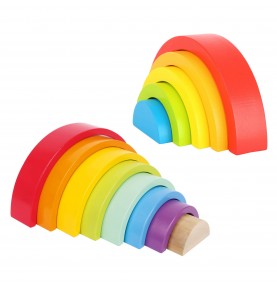
The wooden rainbow is the other great classic at this age: the arches nest inside each other, line up in a row or become a tunnel for little cars. If you are torn between several sizes and materials, our Montessori rainbow comparison will help you decide.

How to choose

Great toys for 1 year olds: six criteria for choosing well

No toy suits every 1 year old, but there are good questions to ask yourself in front of a shelf full of them. These six criteria apply to a purchase just as much as to an everyday object you turn into a Montessori activity: a biscuit tin with a hole cut in the lid, a basket of balls, a colander and some straws.

  1. 1

    It matches the skill they are trying right now

    Watch your child for a week: are they emptying drawers, climbing on everything, trying to push objects into holes? The right toy is the one that offers an organised version of what they are already trying to do.

  2. 2

    It offers one challenge and shows the mistake by itself

    A shape sorter says clearly ‘it fits’ or ‘it doesn't fit’. A toy that flashes, talks and sings all at once scatters attention and leaves nothing for the child to discover alone.

  3. 3

    The child acts, the toy does not act for them

    Choose things that move because your child has pushed, tapped or turned them. A wooden toy without batteries makes them act to get a sound or a movement, and that is exactly what interests them at this age.

  4. 4

    It is the right size and suits their age

    Every part must be too big to fit in the mouth. Read the age given by the manufacturer and look for the warning ‘not suitable for children under 36 months’: it means there are small parts. Check regularly that nothing is coming unstuck or flaking.

  5. 5

    It has weight, texture and real material

    Wood has a temperature, a grain and a weight that changes from one object to the next. Picture books and animals work best when they are realistic: at this age, children discover the world as it is before they enjoy imaginary characters.

  6. 6

    It will last, and can be used in several ways

    A push along walker is a support, then a wheelbarrow; a rainbow becomes a tunnel, a bridge or a cradle; a pounding bench turns into a xylophone. One object that grows with your child is better than three toys quickly forgotten.

Activity board, cube or table: which suits a 1 year old?

Wall-mounted activity boards, or busy boards, bring together latches, zips, buckles and laces. Many parents look for busy boards for 1 year olds, but the ones in our catalogue, such as the locomotive board, are recommended from age 3: their small parts and precise movements are better suited to the practical life work of 3 to 6 year olds.

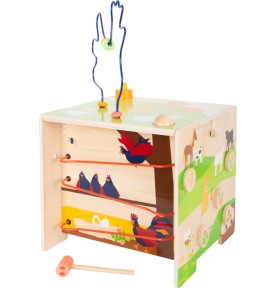
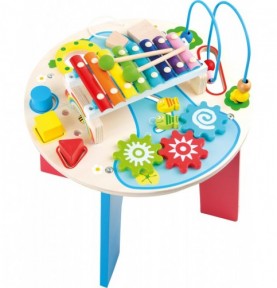
Between 1 and 2, you get the same pleasure of handling things with broader movements: sliding beads along a wire maze, opening a little door, turning a gear, dropping a shape through a hole. An activity cube sits on the floor and can be played with on several sides, sitting or standing: the farm-themed XL cube has five of them. The wooden activity table, recommended from 18 months, brings a xylophone, shape sorter, gears and a bead maze together on a single top, at the height of a standing toddler.

Our advice: whichever you choose, show one activity at a time. Your child will discover the other sides alone, at their own pace.

To try at home

Montessori activities for 1 year olds: six ideas, step by step

A Montessori presentation is short and slow. You show the movement once, in silence or almost, then let your child have a go. If they would rather do something else with the material, safely and without breaking anything, simply watch: they are showing you what really interests them. Always stay beside your child during these activities.

The disappearing ball

From 12 months

You will need: A ball box with a drawer, set on a tray.

  1. 1 Sit down next to your child, with the box in front of them and the ball beside it.
  2. 2 Pick up the ball slowly, show it, hold it over the hole and let go, without saying anything.
  3. 3 Open the drawer, show the ball that has come back, then close it. Hand them the ball and move back a little.
  4. 4 If they cannot find the drawer, leave it open for the first few days.

What comes next: Once they succeed without hesitating, offer a box with a cube or a triangular prism.

The carrying basket

As soon as they walk, around 12-18 months

You will need: A small basket with a handle and three or four sturdy objects (a ball, a block, a little car).

  1. 1 Fill the basket in front of your child, naming each object as you go.
  2. 2 Carry it over to the mat, empty it, then fill it again.
  3. 3 Offer to let them carry it. They will want to do it alone, so let them, even if things fall out on the way.
  4. 4 In the evening, use the same basket to tidy up: the movement becomes a little ritual.

What comes next: Add a heavier object, or a second basket to sort ‘balls’ and ‘blocks’.

Threading onto a rod

Around 15-18 months

You will need: A wooden stacking ring pyramid; at first, only the three largest rings.

  1. 1 Take the rings off one by one, very slowly, and set them side by side.
  2. 2 Put one back on, sliding it right down to the bottom: your child needs to see both the hole and the rod.
  3. 3 Let them thread the rings in whatever order they like. Do not correct the size order.
  4. 4 Add another ring once the first three are mastered.

What comes next: Towards age 2, they will start to notice that one order ‘works better’: that is the right moment to talk about it.

Tap and listen

From 12 months

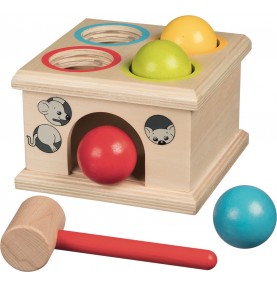
You will need: A pounding bench with its mallet, or a pound and roll box with balls.

  1. 1 Tap a single peg or ball once, then wait: the silence is part of the demonstration.
  2. 2 Hand over the mallet holding it by the handle, to show where to grip it.
  3. 3 If the mallet is used to bang on the table, take it back calmly and show the right surface again.
  4. 4 Stop the activity as soon as they start throwing the mallet: you can offer it again later.

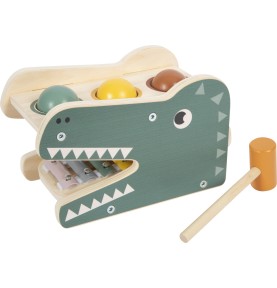
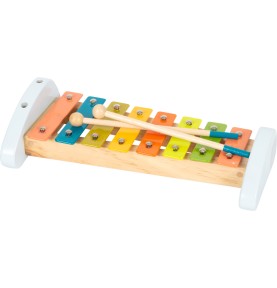
What comes next: Turn the bench over to discover the xylophone: one bar, then two, listening to the difference.

The object and its picture

Around 18-24 months

You will need: Three everyday objects (a spoon, a sock, a ball) and their pictures in a realistic picture book.

  1. 1 Set the three real objects on the mat and name them one by one, in a calm voice.
  2. 2 Show the picture of the spoon and place the real spoon right next to it.
  3. 3 Do the same for the other two, then mix them up and let your child match them.
  4. 4 Do not ask ‘what's this?’: say ‘show me the ball’ instead.

What comes next: Move on to objects that look more alike (a cup and a bowl), then to realistic animal figures.

Pouring water

Around 20-24 months

You will need: A small jug half full of water, a glass, a tray with raised edges and a sponge.

  1. 1 Set everything out on a low table or on the floor, on a towel.
  2. 2 Pour very slowly, holding the jug with both hands, and stop before the glass overflows.
  3. 3 Show the sponge: a spill is not naughty, it is a step followed by a useful movement.
  4. 4 Let your child start again as many times as they like, then empty everything into the sink together.

What comes next: Pouring their own drink at the table, then pouring from one jug into another.

These everyday movements (pouring, wiping, tidying away, putting on slippers) take up more and more room after the second birthday. You will find utensils sized for little hands in our practical life section, and the next stage of the journey in our Montessori toddler guide for 2 to 3 year olds.

The prepared environment

Setting up the space at 1 year: few objects, all at their height

A Montessori space for a 1 year old does not call for a fully furnished nursery. Often it is enough to empty a big toy box, keep one low shelf and look at the room from your child's height: what they can reach, what draws them in, what gets in their way.

Element 01

The low, open shelf

A low, stable unit fixed to the wall, with every level within reach whether your child is standing or sitting. Each toy has its own place, visible and apart from the others, so they can choose alone without asking.

What it changes: They learn where things go, which makes tidying up possible.

Element 02

One tray or basket per activity

The shape sorter sits on a tray, the rings in a basket. Your child picks up the whole set with both hands, carries it to their mat, then brings it back. The container marks out the activity: everything needed is inside.

What it changes: An activity has a beginning and an end, and nothing goes missing.

Element 03

Rotation: 6 to 8 toys on show

Keep the rest in a closed cupboard. Every two or three weeks, swap whatever no longer interests them for a toy that has been put away for a while. Leave in place anything they still use every day.

What it changes: Less choice, more concentration, and toys that feel new again.

Four little corners around the home

A child between 1 and 2 does not only play in their bedroom: they follow you everywhere. Rather than a single play area, think of small landmarks in the rooms where they spend time.

  • A corner for moving

    A thick rug, a firm cushion or a small tunnel to crawl through, and enough room to push the walker without obstacles.

  • A corner for books

    Three or four books displayed face out in a low box, next to a cushion. Swap them at the same time as the toys.

  • A corner for helping

    A hook at their height for their coat, a sturdy step stool by the basin, a kitchen drawer filled with their own utensils.

  • A corner for resting

    A floor mattress or a low bed in a quiet spot, which your child can climb into when they are tired.

Making it safe before opening up the space

A child who walks also climbs. Fix the shelf and any furniture they might climb to the wall, cover sockets and sharp corners at their height, and store cleaning products, medicines and button batteries up high. A stair gate at the top of the stairs is still useful until they can come down safely. It is this groundwork that then lets you leave them to explore without saying ‘no’ every two minutes.

Annotated selection

Our wooden toys for ages 1 to 2, chosen skill by skill

Rather than a list of best rated toys for 1 year olds drawn from sales figures, here are toys we have grouped by skill: walking, fitting shapes, stacking, tapping and naming. Pick one or two toys from each family, depending on what your child is doing at the moment, and keep the others for later. Each card leads to the product page, with its photos and full details.

For a wider choice, all our toys for 1 year old children are listed in the 0 to 24 months section, and the 2 to 3 years section takes over as the second birthday approaches.

For walking, pushing and pulling

The walker gives support during the first steps; push and pull toys take over once walking is secure.

From 1 yearPull along
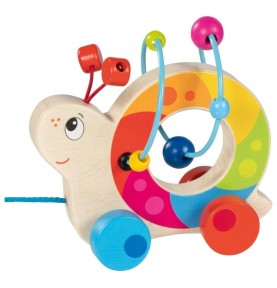
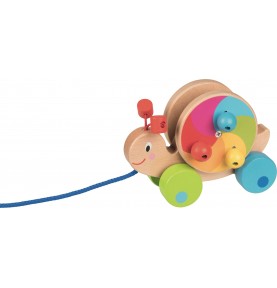
Wooden pull along snail with a cord

Pull-Along Snail Toy

A snail on wheels, pulled along by its cord. It gives a good reason to cross the room and means looking behind you while you walk.

From 1 yearPush along
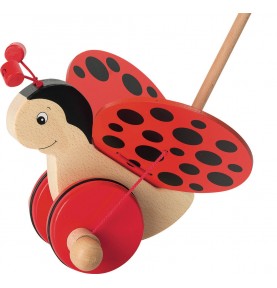
Wooden ladybird push along toy

Ladybird Push Along Toy

Pushed along in front, the ladybird flaps its wings: your child sees straight away that their own walking makes it move.

For fitting shapes and making things disappear

From a single hole to a box with several shapes: choose the box that matches what your child is doing, not their exact age.

From 8 monthsFirst step
Wooden Montessori box with a ball and a drawer

Montessori Ball Box

The ball goes in through the hole and your child gets it back by opening the drawer. The first object permanence box, with a rim that is easy to hold.

From 1 yearSecond step
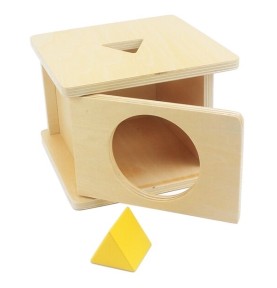
Wooden Montessori shape box with a yellow triangular prism

Montessori Triangle Shape Box

Same idea, but with a triangular prism to turn the right way before it drops: the natural next step once the ball no longer poses a challenge.

For stacking and comparing sizes

Threading, stacking, nesting: three ways to discover that objects are not all the same size.

For tapping, listening and naming

Sound rewards the movement, and a picture gives a word to what your child sees: two doorways into language.

Birthday, Christmas, a new sibling

Developmental toys for 18 month olds: gifts that start from what keeps them busy

Lists of top rated toys for 18 month old toddlers are everywhere, but at this age the best present is the one that matches what the child already does all day long. Ask the parents what is keeping them busy at the moment, then choose from the profile that sounds most like them. For a first birthday, our guide to the best baby toys up to 12 months has ideas too.

A bigger present for an 18 month old, given together

Grandparents, godparents, aunts and uncles: by clubbing together, you can give a more complete toy that will be used for several years. These three are played with at several ages and at several heights.

Good habits before you give a gift

  • One lovely toy is better than three: at 18 months, too many parcels at once tire them out more than they delight them.
  • Ask the parents what is already on the shelf, to avoid a second shape sorter.
  • Check the age given on the product page: a game designed for 3 year olds may contain small parts.
  • Go for a toy that will still be used at 2 or 3: a walker, a rainbow, an activity cube, musical instruments.
  • Remove ribbons, staples and small bits of packaging before handing it to the child.

Looking for another present for 18 month old children? Our 0 to 24 months section brings together all our toys for this age.

Where things often go wrong

Eight common mistakes between 1 and 2

Every parent makes these mistakes, with the very best intentions. Simply knowing about them is often enough to change the habit.

  • Getting everything out at once

    A full toy box makes a child empty it, not play. Keep 6 to 8 toys on show and rotate the rest.

  • Doing it for them to save time

    Putting on a shoe, opening the box, fitting the shape in the right hole: wait a few seconds longer. Helping them succeed on their own is worth more than succeeding for them.

  • Correcting every mistake

    A well-chosen toy shows the mistake by itself. If you correct every time, your child watches your face instead of watching the piece.

  • Buying for the age, not for the child

    A label saying ‘18 months’ does not tell you whether your child is at the dropping stage or the shape-fitting stage. Start from what you observe, while respecting the minimum age given.

  • Talking during the demonstration

    A child cannot listen and watch your hands at the same time. Show in silence, and talk before or after.

  • Interrupting concentration

    When they repeat the same movement twenty times, they are working. No ‘well done’, no question, no change of activity: let them finish.

  • Taking away a toy that seems too easy too soon

    Repeating a movement they have mastered is part of learning. Change the toy when they lose interest, not when they succeed.

  • Forgetting everyday life

    Putting on slippers, carrying their plate, tidying their basket: these moments count as much as toys, and they cost nothing.

Summary

12 to 24 months at a glance

A summary to keep close at hand. The stages overlap: your child may fit into two rows at once.

Montessori milestones, toys and activities from 12 to 24 months
Stage What they are learning Toys to offer Activity in this guide Shop section
12 - 15 months Standing up, first steps, letting go on purpose Ball box, push along walker, pyramid (3 rings) The disappearing ball Baby walkers
15 - 18 months Walking while carrying, fitting a round shape, stacking 2-3 blocks Pull along toy, simple shape sorter, picture book The carrying basket Push and pull toys
18 - 21 months Turning a piece, threading, comparing big and small Shape puzzle, pounding bench, first Pink Tower cubes Threading onto a rod Shape sorters and inset toys
21 - 24 months Pouring, screwing, matching picture and object Activity table, xylophone, wooden fruit to cut Pouring water Stacking and nesting toys
Frequently asked questions

Questions from parents of 1 to 2 year olds

Choosing toys, first steps, the Pink Tower, toys thrown across the room: our answers to the questions we are asked most often.

Which Montessori toy should come first for a 1 year old?

Start with what your child is already trying to do. If they pull themselves up on everything, a stable push along walker with a brake; if they put everything into everything, a single ball box with a drawer; if they poke their fingers into every hole, a pyramid with three or four rings. One challenge per toy, parts too big to go in the mouth, and wood if possible, which has a weight and a texture your child can feel.

A toy idea for a 1 year old that won't clutter up the house?

The ball box, the stacking ring pyramid and a wooden picture book all fit on a single shelf and will be used for months. A basket with three balls of different textures also makes an excellent toy. If you have room for just one large item, the push along walker is the most useful: it is a support for walking, then a cart to fill.

Which Montessori toy for a 16 month old?

At 16 months, most children are walking and love carrying things about. It is a good time for a pull along toy, a simple shape sorter (circle, square, triangle), a first three-piece puzzle and a pounding bench. Keep the ball box if it still interests them: repeating a movement they have mastered is part of the work.

What is the most appropriate toy for 18 month old toddlers?

Around 18 months, hands become more precise and children want to do everything themselves. Think of shape puzzles with several pieces, the first cubes of the Pink Tower introduced with an adult, a xylophone, an activity table and pretend play such as wooden fruit to cut. Rather than relying on lists of top rated toys for 18 month old toddlers, our gift ideas section suggests a choice for each type of child.

How many toys should I leave out for my child?

Six to eight toys on show are plenty between 1 and 2, set out separately on a low shelf. Put the rest away out of sight and rotate every two or three weeks, keeping whatever they still use. Less choice helps them concentrate and tidy up, since each object has a place they can remember.

Is a push along walker better than a sit-in baby walker?

A sit-in baby walker carries the child in a seat: they often move on tiptoe and faster than they could on their own, which is why many early years professionals advise against them. With a push along walker, your child stands on their own, pushes the handle and lets go whenever they decide to. Choose one with a heavy base and a brake, and keep the brake on at first.

From what age can you introduce the Pink Tower?

Our Pink Tower is recommended from 18 months, with an adult present. At this age, offer only the three or four largest cubes and keep the smallest ones, which measure less than one centimetre, out of reach. Your child carries them, puts one on top of another and compares them. The whole tower, built alone in the right order, tends to come at around two and a half or three.

My child isn't walking yet at 15 months: which toys should I offer?

The age at which children walk varies a great deal, and it is common for a 15 month old not to be walking yet. Give them ways to pull up to standing and move about while holding on: a low, stable piece of furniture, a push along walker with the brake on, toys placed a little further away to make them want to move. If you have any doubts, especially if they are still not walking at around 18 months, talk to your GP or health visitor.

My child throws all their toys: what should I do?

Throwing is a skill they are learning: letting go on purpose, watching the object fall, hearing the sound. Give them a place where it is allowed, such as a ball box or a large basket to throw fabric balls into. If a wooden toy gets thrown, take it back calmly, simply say ‘the block stays on the mat’, and offer a ball instead.

Should electronic toys be avoided at this age?

They are not forbidden, but they often do the work instead of the child: one button sets off lights and songs, and there is not much left to discover. A xylophone, a pounding bench or a pound and roll box only makes a sound when your child acts, and a different sound depending on how hard they tap. It is this direct link between their movement and the result that interests them.

When should we move on to Montessori activities for 2 year olds?

There is no fixed date. When your child fits several shapes without hesitating, threads, pours and wants to join in with every household task, you can introduce transferring activities, first puzzles with several pieces and more practical life activities. Our guide for 2 to 3 year olds takes over with ideas suited to that age.

First Steps & Motor Skills

Montessori Toys 1 to 3 Years

Walkers, object permanence boxes and shape sorters to develop motor independence.