Handcrafted natural solid wood toys & safe non-toxic finishes
All ages, from 0 to 6 years
A guide to the first year

Best baby toys from 0 to 12 months: the Montessori guide Milestones, materials, a movement area and activities

The best baby toys are neither the loudest nor the busiest: they are the ones that match what your child is learning to do at that precise moment, whether that means grasping, mouthing or passing an object from one hand to the other. This guide follows your baby from birth to their first birthday, one quarter at a time.

For each stage, you will find the developmental milestones to look out for, the materials worth offering (mobiles, a grasping ball, wooden rattles, an object permanence box), how to set up a floor-based movement area inspired by the Nido, and activities to introduce step by step. In Maria Montessori's approach, a toy for a very young child does one thing only, with no batteries and no flashing lights, and leaves the child free to act on their own.

Wood and fabric, simple shapes
Reading time: 20 min
No batteries, no screens
Free movement on the floor
Q1
From birth to 3 months

Developmental toys for infants from birth to 3 months: looking, listening, finding their hands

Faces, contrasts, mobiles

In the first weeks, your baby sees most clearly what is 20 to 30 cm from their eyes: roughly the distance to your face during a cuddle or a feed. They are drawn to bold contrasts, to faces and to the voices they already know. At this age, a developmental toy is something to look at and listen to far more than something to handle.

The rest of the time, what they mostly need is to move without restriction. Lying on their back on a firm mat, they wave their arms and legs, turn their head towards the light and gradually discover that their hands belong to them. One or two well-chosen objects are plenty; what matters most is you, your voice and time spent on the floor.

Milestones to look out for

  • They fix their gaze on a face, then follow it with their eyes over a short distance, at around 1 to 2 months.
  • The first smiles in response to yours often appear between 6 and 8 weeks.
  • They grip a finger or an object placed in their palm by reflex, without being able to let go on purpose.
  • Lying on their tummy, they lift their head for a few seconds, then for longer and longer.
  • At around 2 to 3 months, their hands open more and they start to look at them.

What you can offer

  • A visual mobile hung above the mat, changed every two or three weeks (see the mobile sequence further down).
  • A mirror fixed to the wall just above the mat, where they can watch the room move and see their own movements.
  • A very light rattle, placed near their hand at around 2 or 3 months, rather than slipped between their fingers.
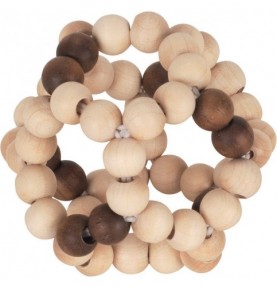
  • A soft ball that is easy to grasp, such as the grasping ball with a bell: suitable from birth, it really comes into its own once the hands start to open.

How to present things

Keep sessions short and offer one object at a time. When your baby turns their head away, yawns or becomes fretful, they have had enough: take the mobile down and let them rest. Several times a day, also lay them on their tummy for a few minutes on a firm mat, always awake and always within your sight: tummy time strengthens head control and gives them a different view of the world.

If you would like to go further, we have brought together the best toys for newborns and for the months that follow in a single range.

Q2
From 3 to 6 months

From 3 to 6 months: reaching, tasting, swapping hands

Grasping ball and rattles

From around 3 months, the hands become the great subject of study. Your baby looks at them, brings them together and puts them in their mouth. Then they reach out towards whatever interests them and end up catching hold of it deliberately: this is voluntary grasping. Everything they pick up goes straight to the mouth, which at this age remains their best tool for exploring a shape, a texture or a temperature.

At what age do babies start holding a rattle?

From birth, a baby will grip a rattle slipped into their palm, but this is a reflex: they can neither direct it nor let it go. At around 3 months, with their hands more open, they hold on for a while to a light rattle they have brushed against and shake it without really meaning to. Between 4 and 5 months, they reach out and pick up a rattle placed within reach. By around 6 months, they pass it from one hand to the other and shake it to hear the sound. These ages vary by several weeks from one child to the next, so watch what your baby actually does rather than the calendar.

Milestones to look out for

  • They bring their hands together above their chest and study them for a long time.
  • They reach out towards an object and grasp it on purpose, at around 4 to 5 months.
  • They take everything they hold to their mouth: this is how they get to know a shape and a material.
  • They roll from their back onto their side, then from back to tummy, often between 4 and 6 months.
  • At around 6 months, they pass an object from one hand to the other.

What you can offer

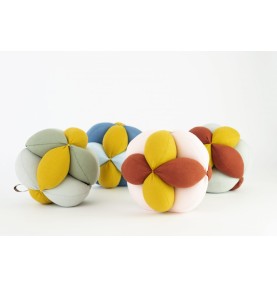
  • A grasping ball made of soft segments, such as the Montessori fabric clutch ball: it can be caught from any side, even by fingers that are still clumsy.
  • A light wooden rattle: a single ring, a double ring or threaded beads. A double-ring rattle with beads can be held in one hand and passed easily into the other.
  • Something to chew on while the first teeth are coming through: our range of the best teething toys brings together wooden and fabric designs.
  • A variety of textures: smooth wood, fabric, beads. Two or three objects at a time, no more.

How to present things

Place the object on the mat, 15 to 20 cm from their hand, rather than putting it between their fingers. It is the effort of reaching it that keeps them busy: if they roll onto their side to catch it, the activity has done its job. Move the object from one day to the next, a little to the right, a little to the left, to encourage them to turn towards both sides.

More sensory toys for babies that suit this age: rolling sound toys, fabric balls and small soft animals.

Q3
From 6 to 9 months

From 6 to 9 months: what are the best six month old toys?

Sounds, rolling objects, permanence

At around 6 months, your baby holds their head steadily, rolls over in both directions and starts to push up on their arms. Once they can sit without support, both hands are finally free to handle things. The best six month old toys keep pace with these new skills: an object to shake so they can hear the effect of their own movement, an object that rolls a little way to make them want to move, and then, at around 8 months, a box in which a ball disappears and comes back.

At this age, they repeat the same action tirelessly: drop it, pick it up, drop it again. This is not naughtiness; it is an experiment they keep running until they are sure of the result. A toy that always gives the same response to the same movement therefore suits them far better than one that keeps changing its sounds or lights.

Milestones to look out for

  • They sit up on their own, at first leaning on their hands, most often between 6 and 8 months.
  • They bang two objects together and drop whatever they are holding just to watch it fall.
  • They pick up small things with the whole hand, in a raking movement, before using the thumb and the side of the index finger.
  • At around 8 months, they look for an object they have just seen being hidden: object permanence is taking shape.
  • They pivot and crawl on their tummy; some move on to crawling on all fours as early as 8 or 9 months.

What you can offer

  • A sound object to shake, such as the wooden sound egg, recommended from 6 months: small enough to fit in one hand, it responds to the slightest movement.
  • An object that rolls slowly, such as the musical roller, with beads that can be seen moving inside: placed a little further away, it gives them a reason to crawl.
  • The object permanence box, from 8 months and once they can sit up unaided: the Montessori ball box is first presented without its drawer.
  • A treasure basket of safe, everyday objects that are large enough (see the step-by-step activities).

How to present things

Let them find the sitting position by themselves rather than propping them up between cushions: this is a recommendation shared by Maria Montessori and Emmi Pikler. A baby who sits up alone also knows how to get out of that position, lean over to pick up an object and catch themselves. In the meantime, the floor remains their best playground, on their tummy as well as on their back.

To compare other designs, browse our selection of toys for 6 month old babies and older, or the whole sensory and discovery toys range.
Q4
From 9 to 12 months

Good toys for infants from 9 months to the first birthday

Emptying, filling, stacking, standing

The last quarter is all about movement. Your baby gets about on all fours or by crawling on their tummy, pulls up to stand against a low piece of furniture, then cruises along the sofa holding on. Their fingers become more precise and they discover that they can let go of an object exactly where they want.

The activities that keep them busiest around their first birthday revolve around three actions: putting in, taking out and stacking. A box and a few balls, a basket to empty, a pyramid with a few pieces: the materials stay simple, because it is the repetition that counts. They also begin to imitate: they lift the comb to their hair, hold the phone to their ear and bang on a drum after you.

Milestones to look out for

  • They pick up a crumb between thumb and index finger: the pincer grasp becomes more precise between 9 and 12 months.
  • They let go of an object exactly where they want, in a box or in your hand.
  • They pull themselves up to stand, then move along holding on to the furniture, often at around 10 to 12 months.
  • They point, copy your gestures (clapping, waving, peekaboo) and understand familiar words.
  • First steps come anywhere between 9 and 18 months: the range is wide and perfectly normal.

What you can offer

  • A stacking pyramid: the Safari stacking pyramid, recommended from 1 year on its product page, is first offered with just two or three pieces.
  • A basket to empty and fill: fabric balls, large blocks, scarves. They enjoy emptying just as much as filling.
  • The object permanence box with its drawer, then a first box with a single round shape.
  • Something to pull up on: a low, stable piece of furniture is enough. To find out when a push along walker becomes useful, read our guide to walkers for one year olds.

How to present things

Make the room safe rather than forbidding things: put fragile objects away, cover the sockets and fix to the wall any furniture they pull up on. Saying ‘no’ all day long wears everyone out; a room designed with them in mind lets you say ‘yes’ to almost everything. A low shelf with four to six activities, each in its own basket, lets them choose and put things back.

Looking for a toy for a nine-month-old, or one a little older? Our 6 to 12 months selection brings together the designs suited to this last quarter.

The first three months

The Montessori mobile sequence: four mobiles for the first weeks

A Montessori mobile is not a toy to grab: it is something to look at, hung above the play mat, that accompanies your baby's gaze during the first three months. Traditionally, four are offered one after another, from the most contrasted to the most colourful, and from the stillest to the one that moves the most.

Mobiles are not part of our catalogue. Many parents make their own with card, shiny paper and fine thread; the guidance below is there to help you introduce each one at the right moment, whether it is home-made or bought elsewhere.

  1. Mobile 01 From about 3 to 6 weeks

    The Munari mobile

    Black and white geometric shapes and a transparent sphere that catches the light. Maximum contrast suits eyesight that is still blurred and barely tells colours apart.

  2. Mobile 02 From about 6 to 8 weeks

    The octahedron mobile

    Three octahedrons in shiny paper, red, yellow and blue. The facets reflect the light differently with every turn, so your baby discovers primary colours and volume.

  3. Mobile 03 From about 2 to 3 months

    The Gobbi mobile

    Five spheres in a single colour, from the darkest shade to the lightest, hung on a diagonal. The eye glides from one shade to the next: it is the calmest of the four.

  4. Mobile 04 From about 3 months

    The dancers mobile

    Four figures in metallic paper that turn at the slightest breath of air. The movement is livelier: by now, your baby can follow an object travelling across the whole field of vision.

After the mobiles to look at, the mobiles to touch

At around 3 or 4 months, when your baby starts to reach out, the visual mobile is replaced by an object hung within reach of their hands: a wooden ring on a ribbon, a small bell, a little fabric ball. At first they hit it by chance, then they aim, catch it and pull on it. This kind of mobile is always offered while you are watching, on a short ribbon that is firmly attached. It is the natural stepping stone towards the rattle they will hold by themselves a few weeks later.

How do you hang a Montessori mobile?

  • 1. A secure fixing A hook screwed into the ceiling or a stable stand placed beside the mat. Never just sticky tape: check the fixing and the state of the thread every time you change the mobile.
  • 2. The right distance About 25 to 30 cm above your baby for the Munari mobile, the distance at which they see clearly. You can raise the following ones a little as their sight reaches further.
  • 3. Slightly off-centre Above the chest rather than directly above the face: they can look at it without twisting their neck, and look away when they have had enough.
  • 4. Out of reach Visual mobiles are made of paper and thread, so your baby must not be able to reach them with hands or feet. Take them down as soon as they manage to touch them.
  • 5. Over the play mat, not over the cot The mobile goes with the times when your baby is awake and alert. The cot stays a place for sleep, with nothing hanging above it.
  • 6. A short time, then change A few minutes are enough. When they have not looked at it at all for several days, move on to the next mobile, usually every two to three weeks.
A prepared space on the floor

Setting up a movement area: the Nido at home

In Montessori education, the Nido (‘nest’ in Italian) is the setting that welcomes babies from a few weeks old until they take their first steps. At home, the main idea to keep is simple: a corner of the living room, at floor level, where your child can move freely while you keep an eye on them, without a bouncer or a playpen holding them in place all the time.

You do not need a whole room or a big budget: four elements are enough, and they change with your baby as the months go by.

Element 01

A firm mat on the floor

A thick but firm mat, or a thin mattress, large enough for your baby to roll over several times. On the floor there is no risk of falling, they can see the whole room, and they will be able to leave the mat as soon as they start to crawl.

The test: they can move their arms and legs without being held back
Element 02

A mirror at mat level

A shatterproof mirror fixed horizontally along the wall, just above the mat. As they wave their arms, your baby sees the image move at the same time and gradually links what they feel with what they see.

The test: firmly screwed in place, with no sharp edges
Element 03

A hanging point above the mat

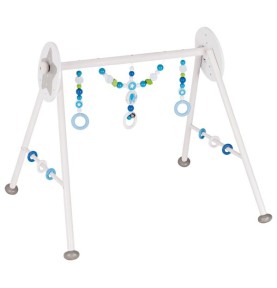
A ceiling hook or a stable stand from which to hang the mobiles, then the objects to touch from around 3 or 4 months. A wooden activity arch placed over the mat does the same job and is easy to move.

The test: only one object hanging at a time
Element 04

A low shelf and a few baskets

A low piece of furniture, at the height of a crawling baby, holding just four to six objects, each in its own basket. By rotating them regularly, you keep their interest without cluttering their field of vision.

The test: one object per basket, always in the same place

If you would rather have a ready-made structure than a ceiling hook, our wooden baby activity arch stands over the mat and can be put away once your baby no longer needs it.

Checking the movement area is safe

  • No object small enough to fit entirely in their mouth, and no part that could come loose.
  • No cord, ribbon or long tie within reach; dummy clips stay short and are used only when you are there.
  • Sockets covered, electric cables tidied away, and furniture fixed to the wall as soon as they start to pull themselves up.
  • A clean, clear floor around the mat: they will go further than expected, sooner than expected.
  • The movement area is for the times when they are awake; sleep happens in their cot, on their back, with no pillow and no toys.

The adult's role: present, without interrupting

When your baby is absorbed in their reflection or turning a rattle over and over, resist the urge to comment or to hand them another object. These moments of concentration are precious and often short. Stay close by and available: if they look round for you, answer with a smile or a few words, then let them pick up where they left off.

How to choose

How to choose good infant toys for a baby under one

Lists of top rated infant toys mostly rank products by popularity. Before 12 months, though, a good toy is recognised less by its brand or its star rating than by the way your child actually uses it. Whether you are looking for a first rattle or the best baby toys for a six-month-old, six criteria will help you sort through the options quickly, in a shop as well as online.

  1. Criterion 1

    Only one thing to discover

    A sound, a texture or a movement. An object that does everything at once (lights, music, voices) leaves little room for what the child does by themselves.

  2. Criterion 2

    Suited to the skill of the moment

    Looking before 3 months, grasping between 3 and 6 months, shaking and rolling after that, then putting in and stacking at around 10 months. A toy that is too advanced is quickly ignored.

  3. Criterion 3

    The right size, the right weight

    Too big to fit entirely in their mouth, light enough to lift with one hand. If it slips and lands on their face, it must not hurt them.

  4. Criterion 4

    Simple materials

    Smooth wood, fabric, securely fixed beads: surfaces they can chew, easy to wipe or wash, with no splinters and no flaking paint.

  5. Criterion 5

    Your baby makes it happen

    With no batteries and no screen, the sound or movement only exists if they act. This way, they understand very early on the link between their movement and what happens.

  6. Criterion 6

    The stated age, and a regular check

    Respect the minimum age shown on the product page and on the packaging. Check the condition of toys from time to time and remove anything cracked or coming apart at the seams.

Which Montessori rattle should you choose?

In the shops, a rattle is often a plastic object that makes a loud noise. In the Montessori approach, a rattle is an object to hold whose sound stays discreet, and the right Montessori rattle is chosen according to what the hand can already do:

Before 3 months A very slim, very light rattle that is easy to grip: two wooden discs joined together, or a thin ring. They will hold it by reflex at first, then for longer and longer.
From 3 to 5 months A ring or a ball that can be caught from any side, with a soft sound inside. Your baby discovers that it is their own movement that makes the noise.
From 5 to 8 months A double ring, a rattle with beads or a jointed rattle to handle and pass from one hand to the other, and to chew on while the first teeth are coming through.

Whatever its shape, hold it in your own hand before giving it: it should be light, with no sharp edges, and none of its parts (beads, bell, rings) should be able to come loose.

Wood

Smooth, warm to the touch and with a real weight, wood tells your baby something about the material itself. Wipe it with a barely damp cloth and never leave it to soak.

Fabric

Soft and light, fabric suits the very first grasps and balls that can be thrown without risk. Wash it according to the manufacturer's label.

Plastic

Not forbidden, but often paired with automatic sounds and lights. If it has a single, simple function and your baby sets it off themselves, it can have its place.

Annotated selection

Our pick of the best baby toys, from birth to the first birthday

Rather than another list of best rated infant toys, here are objects from our own catalogue, sorted by stage. Around six months, the right toy often sits at the hinge between the two groups: first a rattle they pass from hand to hand, then something to shake. For each object, we explain which skill it responds to and how to present it. The age shown is the one recommended on the product page, where you will also find the materials and dimensions.

Montessori baby toys 0-6 months: looking, grasping, chewing

From birthFabric
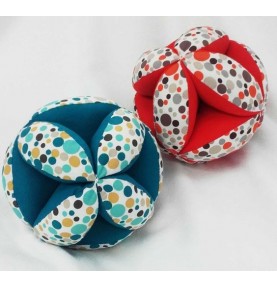
Montessori fabric grasping ball with a bell

Grasping ball with a bell

A soft ball about 15 to 17 cm across, with openings that little fingers slip into easily; the bell answers the slightest movement.

Place it near their hand at around 3 months: it is often the first object a baby catches on purpose.

From 3 monthsBeech
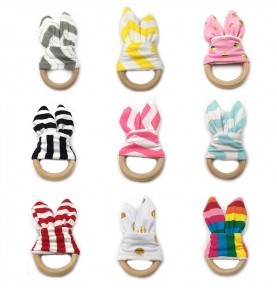
Beech wood teething ring in the shape of an animal

Beech wood animal teething ring

Cut from a single piece of beech: nothing to take apart and nothing to come loose. Firm and smooth, it is held by its cut-out shape and can be chewed while the first teeth are coming through.

From birthWood
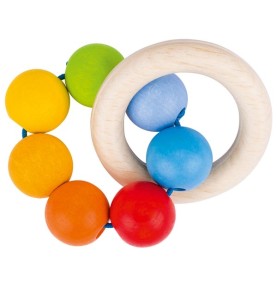
Wooden double-ring baby rattle with beads

Double-ring rattle with beads

Two wooden rings and beads that slide: a light sound when it is shaken, and two places to hold it, one for each hand.

At around 5 or 6 months, it is a good object for practising passing from one hand to the other.

From 6 to 12 months: shaking, searching, stacking

From 6 monthsWood
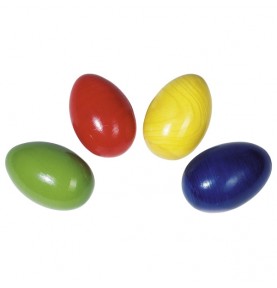
Montessori wooden sound egg with a white musical note

Wooden sound egg, white note

It fits in a single hand and makes a muffled sound as soon as it is shaken. Sold individually or in a box of five: with two eggs, you can play copying games together.

From birthMusical
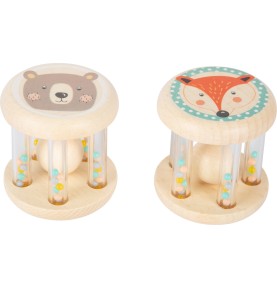
Pastel musical roller with animal designs

Pastel musical roller

A cylinder that rolls gently, with wooden balls and coloured beads visible inside.

Placed a little further away on the mat, it gives your baby a good reason to crawl over and fetch it.

From 8 monthsMusical
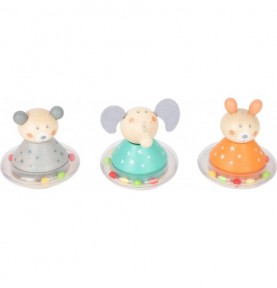
Wooden roly-poly animals with a ring of beads

Roly-poly animal tumbler with beads

Pushed with a finger, they wobble and then spring back upright while the beads in the ring jingle. The same movement always gives the same result: exactly what your baby is trying to check at this age.

From 8 monthsWood
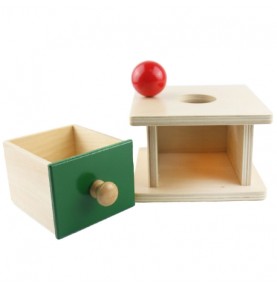
Montessori wooden box with a ball and a drawer

Object permanence box with ball

Your baby drops the ball into the hole, it disappears, and then they open the drawer to find it again.

Present it first without the drawer, as soon as they can sit up unaided: the ball rolls straight back out and the first success comes more easily.

From 1 yearWood
Wooden stacking pyramid from the Safari collection

Safari stacking pyramid

A base with a central post, six graduated pieces decorated with animals and a half-sphere on top.

Start with the two largest pieces; the order and the complete picture will come in the following months.

To try at home

Five step-by-step activities for the first year

Inspired by the Montessori approach, these activities need very few materials and can be repeated for weeks on end. Your role is to prepare, show once if needed, and then observe without doing it for them.

  1. 1 From the first weeks

    Tummy time in front of the mirror

    Materials: A firm mat and a mirror fixed at floor level.

    1. Lay your baby on their tummy facing the mirror, with their arms tucked under their shoulders.
    2. Lie down opposite them, at their level, and talk to them softly.
    3. Stop as soon as they protest: a few minutes are enough, several times a day, always awake and always within your sight.

    What next: Once they hold their head up and push up on their forearms, place a colourful object in front of them, just out of reach.

  2. 2 From about 3 to 5 months

    Catching the ball

    Materials: A soft grasping ball, or a very light rattle.

    1. Your baby lies on their back; place the ball on the mat, next to their hand.
    2. Wait without helping: they look at it, brush against it and end up catching it.
    3. If they take it to their mouth, let them: this is how they get to know it.
    4. The next day, place it on the other side.

    What next: When they catch it without effort, move it a few centimetres further away so that they roll onto their side.

  3. 3 From about 6 to 9 months, sitting

    The treasure basket

    Materials: A low, sturdy basket and six to ten everyday objects that are large enough: a wooden spoon, a small whisk, a metal cup, a cotton scarf, a wooden ring, a fabric ball.

    1. Place the basket in front of them, within reach, and sit down beside them.
    2. Let them choose, turn, bang and taste each object for as long as they like.
    3. Name the object once if they hold it out to you, without commenting on every move.
    4. Each week, swap one or two objects for new ones.

    What next: Check the size and condition of the objects every time, and always stay close by during this game.

  4. 4 From about 8 to 10 months

    Hide, search, find

    Materials: A ball, a light scarf, then an object permanence box.

    1. In front of them, hide half the ball under the scarf: they pull on it and find the ball again.
    2. When that becomes easy, hide the ball completely.
    3. Then move on to the permanence box without its drawer: the ball drops in and rolls straight back out.
    4. Put the drawer back once they succeed time after time.

    What next: When the box with its drawer holds no more secrets, offer a box with a single round shape.

  5. 5 From about 10 to 12 months

    Putting in, taking out

    Materials: A large bowl or a box with a wide opening, and four or five fabric balls or large blocks.

    1. Show the movement once only, slowly and without talking: one ball into the bowl.
    2. Let them do it their own way, including tipping everything out to start again.
    3. Once they have mastered it, make the opening smaller: a box with a round hole.
    4. Then offer a pyramid with two or three pieces.

    What next: Around the first birthday, single-piece puzzles and first shape sorters take over.

First birthday

A gift for the first birthday: ideas that follow their new skills

At one year old, your child pulls up to stand, bangs on anything that makes a noise, stacks things up and knocks them down. A present for this first birthday is therefore well worth choosing to match one of these new skills, and to stay interesting until the age of 2 by being played with in several different ways as the months go by.

If family and friends ask you for gift ideas for the big day, give them one simple rule: a single rich object rather than five small ones that are all alike, and presents that complement each other (something that makes a sound, something to stack, something to pull up on).

From 12 monthsWood
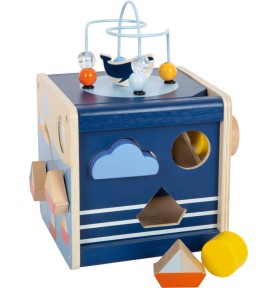
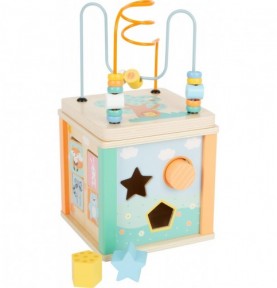
Ocean wooden activity cube with five sides to play with

Ocean activity cube

Five sides to play with: gears to turn, an abacus, a bead maze and shapes to sort. It is played with sitting on the floor, one side after another.

At one year old, your child will mostly slide and turn things; the shapes to sort will really make sense at around 18 months.

From 12 monthsWoodTwo in one
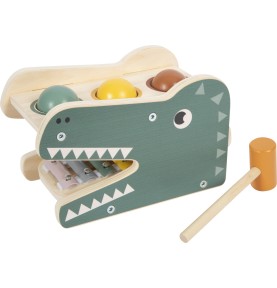
Wooden pounding bench with a Safari crocodile xylophone

Safari pounding bench and xylophone

A pounding bench with three wooden balls and a removable xylophone shaped like a crocodile.

At first, your child pushes the balls in with their hand and watches them disappear; aiming and hitting will come later. The xylophone lifts off so it can be played on its own.

  • For tapping and listening A drum, a xylophone, a sound egg: they hear straight away what changes when they hit harder or more gently.
  • For handling An activity cube or a stacking pyramid, which grow with them right up to the age of 2.
  • For standing up A stable push along walker, to offer once they already pull up to stand on their own.

And after the candle has been blown out? Our guide to Montessori toys for 1-2 year olds takes over, with shape sorters, push and pull toys and the first practical life activities, right up to the age of 2.

To avoid

Seven common mistakes in the first year, and what to do instead

They almost always start from a good intention: to please, to stimulate, to save time. Putting them right costs nothing.

  • Putting all the toys out at once Three to six objects at a time, each in its own place. The rest wait in a cupboard and come back a week or two later, as good as new in your baby's eyes.
  • Choosing by the age on the label alone The minimum age is still a limit to respect, but it is the skill of the moment that should guide your choice: if they are not grasping yet, a ball placed beside them will keep them busier than an activity cube.
  • Putting the object straight into their hand Place it within reach and wait. It is by stretching out their arm and opening their hand that they learn to grasp.
  • Putting them in a position they cannot get into alone Propped up between cushions, held standing, or left for a long time in a seat, they can neither change position nor go and fetch an object. On the floor, they move at their own pace.
  • Interrupting a moment of concentration If they are absorbed, even in something that looks trivial to you, wait until they look up at you before offering something else.
  • Piling on automatic sounds, lights and screens Choose objects that do nothing until your baby sets them off. Calm surroundings help them notice what their own movement produces.
  • Leaving older siblings' toys lying around Small parts, marbles, threading beads: store them up high or in another room as soon as your baby starts to get about.
At a glance

Summary table from 0 to 12 months: skills, materials, activities

AgeWhat they doMaterials to offerKey activityTo avoid
0 to 3 months Watches faces and contrasts, grips by reflex, lifts their head on their tummy Visual mobiles, a mirror at floor level, a very light rattle Tummy time in front of the mirror An activity arch loaded with lights, long hours in a bouncer
3 to 6 months Discovers their hands, grasps on purpose, mouths everything, rolls over Grasping ball, wooden rattles, something to chew, a mobile to touch Catching an object placed beside their hand Slipping the object into their hand
6 to 9 months Sits up alone, swaps hands, bangs, drops things, crawls Sound egg, roller, roly-poly toy, treasure basket, permanence box from 8 months The treasure basket Propping them up between cushions
9 to 12 months Pincer grasp, pulls up to stand, cruises along furniture, imitates Stacking pyramid, single-shape box, balls to put in, low furniture to pull up on Putting in, taking out Older siblings' toys with small parts within reach

The ages in this table are averages: a gap of several weeks, one way or the other, is common. For what comes next, from 1 to 6 years, our guide to Montessori toys by age presents each stage in the same way.

Parents' questions

Your questions about Montessori play from 0 to 12 months

Short answers to the questions parents ask most often, from birth to the first birthday.

When do babies start holding a rattle by themselves?

The grasp reflex makes a baby grip a rattle from birth, but without being able to let go of it on purpose. Voluntary grasping usually arrives between 4 and 5 months: your baby reaches out towards a rattle placed within reach and takes hold of it. At around 6 months, they pass it from one hand to the other. This is the moment to choose a light rattle that is easy to hold, with a discreet sound.

What are the best developmental toys for infants around six months?

At six months, the best baby toys are the ones that match what your child is doing at that age: grasping, shaking, swapping hands and tasting everything. A wooden rattle or sound egg, a grasping ball and an object that rolls gently cover the essentials. At around 8 months, once they can sit up alone, the object permanence box takes over. Two or three well-chosen objects are worth more than a basket full of toys.

See our sensory and discovery toys range

What should you offer a baby in the first weeks?

Very little: a firm mat on the floor, your face, your voice and, from around 3 weeks, a first black and white mobile. Your baby still spends a lot of time sleeping and feeding, and the moments when they are awake and alert are short. A very light rattle becomes useful at around 2 or 3 months, when their hands open.

Why does the Montessori approach limit bouncers and playpens?

Maria Montessori, like the paediatrician Emmi Pikler, insisted on freedom of movement. In a bouncer, a baby stays in the position they were put in; in a playpen, they see the world through bars. This equipment can help out for a few minutes, but most of their waking time is better spent on the floor, on a firm mat, where they learn to roll, to push up on their arms and then to crawl.

My baby puts all their toys in their mouth: is that normal?

Yes. During the first year, the mouth is one of the main ways a baby discovers a shape, a texture or a temperature. Choose objects that are too big to fit entirely in their mouth, made of smooth wood or washable fabric, with no small part that could come loose, and check their condition regularly.

What is object permanence?

It is the understanding that an object or a person goes on existing when it can no longer be seen. It develops gradually from around 8 months, the age at which many babies protest when their parent leaves the room. Peekaboo games with a scarf and the object permanence box, in which a ball disappears and then reappears in a drawer, let them test this idea again and again.

See the object permanence box with ball

How many toys should be left within reach?

Fewer than you might think. Before 6 months, two or three objects are enough. Between 6 and 12 months, four to six activities on a low shelf, each in its own basket. The other toys stay put away: when your baby loses interest in an object, swap it for another, then bring it out again a week or two later.

What is the difference between an ordinary rattle and a Montessori rattle?

Many shop-bought rattles play music or light up by themselves. A Montessori-inspired rattle, often made of wood, has only one feature to discover: a shape that is easy to grasp, a discreet jingle, rings that slide. The sound only exists if your baby moves, so they understand the link between their movement and what they hear.

Should you buy a Montessori mobile or make one?

Both work. We do not sell mobiles, and many parents make them from card, shiny paper and fine thread, following the Munari, octahedron, Gobbi and dancers sequence. Home-made or bought, a mobile must be securely fixed, out of your baby's reach and kept for the times when they are awake on the play mat.

How do you clean wooden and fabric toys?

Wipe wood with a barely damp cloth, with a little mild soap if needed, then let it dry in the open air: avoid soaking it or putting it in the dishwasher. Fabric toys are washed according to the manufacturer's label. In every case, remove any toy that is cracked, flaking or coming apart at the seams.

Should you play with your baby or let them play alone?

Both, at different times. Exchanging looks, singing songs and playing peekaboo are among their favourite moments. But when they are exploring an object on their own, your role is to stay close and available without interrupting. If they look round for you, respond, then let them carry on.

What comes after 12 months?

Single-piece puzzles, shape sorters, push and pull toys, and a push along walker once they pull up to stand on their own. Everyday tasks (drinking from a cup, tidying up, helping to lay the table) also start to interest them. Our guide from 1 to 2 years covers these stages in detail.

Read our guide to Montessori toys for 1-2 year olds

Babies & Sensory Play

Early Learning Toys 0 to 12 Months

Natural wooden materials, rattles and grasping balls designed for first sensory discoveries.