Handcrafted natural solid wood toys & safe non-toxic finishes
Montessori guides
In-depth guide: the approach

Montessori definition: the Montessori method explained From Maria Montessori to family life, from birth to 6

A short Montessori definition to begin with: the Montessori method is an approach to education that started in Rome in the early twentieth century, based on a simple observation. Children learn through their own activity, provided they find surroundings built to their scale and an adult who watches before stepping in. Devised by Maria Montessori, a doctor, from what she saw children actually do, it is now practised in schools all over the world and, more and more often, at home.

This guide brings the essentials together: who Maria Montessori was, the key principles of her approach, the role of the adult and of the materials, what Montessori education offers at each age, how to apply it at home without buying everything new, and how it differs from other approaches to education.

Mainly looking for the materials themselves and how to choose them? Our guide What are Montessori toys? answers that question in detail, from birth to 6.

The essentials in four points

  • Observe first: The adult watches what interests the child, then prepares the setting accordingly, instead of imposing a programme.
  • Surroundings at their height: Low furniture, real objects, only a few things out at a time and each in its place: the child can act without asking for help.
  • Freedom within limits: The child chooses an activity and spends as long as they like on it, while respecting others, the materials and a few clear rules.
  • Materials that show the mistake: The child sees for themselves what has gone wrong and tries again, without waiting for an adult to correct them.
1907, Rome The first Casa dei Bambini
From 0 to 6 The age of the absorbent mind
Observe, present Then let the child do it
One difficulty at a time For materials easy to read
Overview

What does Montessori education mean?

The simplest Montessori education definition is this: a way of bringing up and teaching children that trusts their own drive to learn. It relies neither on whole-class lessons nor on drills imposed from outside, but on carefully prepared surroundings in which the child chooses what to do, at their own pace, with objects designed so that they can succeed on their own. You will hear people talk about the Montessori method, the Montessori approach or Montessori education: all three refer to the same thing.

Behind the word ‘method’ lies less a list of exercises than a way of looking at the child. Maria Montessori saw the child as a capable person, driven by a deep need to understand and to act, and saw the adult as someone who opens the way rather than someone who fills a child up with knowledge. Everything else follows from that: the layout of the room, the materials and the attitude of the teachers.

How does the Montessori method of teaching work?

In practice, the Montessori method of teaching rests on three elements that work together. If one of them is missing, the other two lose their meaning: beautiful materials set out in a cluttered room achieve nothing, and neither does an attentive adult with nothing to offer.

The child

Chooses an activity, repeats it as often as needed and learns through their own movements. Everything starts from what interests them, not from a programme set in advance.

The prepared environment

An orderly space at the child’s size, where every object has a place and a purpose. Much of the time, it is the environment itself that does the ‘teaching’.

The adult

Observes, prepares the setting, shows a movement when the child is ready, then steps back. The adult intervenes rarely, but at the right moment.

The four planes of development

Maria Montessori divided growth, from birth to adulthood, into four periods of six years, which she called the ‘planes of development’. Each one has its own needs, and education has to change shape from one plane to the next: you do not offer a 9-year-old what fascinates a 3-year-old.

0 to 6 years

Early childhood

The child builds their body, their language and their movements: this is the age of the absorbent mind, the focus of this guide.

6 to 12 years

Childhood

Children reason, imagine, ask ‘why?’ again and again and enjoy working in groups.

12 to 18 years

Adolescence

Young people look for their place in society; Montessori pictured a setting for them that was close to real life.

18 to 24 years

Adulthood

Maturity: the young adult chooses a path and, in turn, contributes to society.

Montessori teaching in the classroom

In a classroom, Montessori teaching takes a recognisable form. Children of three different ages share the same room (3 to 6, 6 to 9, 9 to 12): the youngest watch the older ones, and the older ones consolidate what they know by helping the little ones. The morning leaves a long, uninterrupted work period, during which each child chooses an activity from the shelves, settles at a table or on a small rug, then puts it away before moving on to something else. The teacher moves around the room, observes and gives presentations to one child at a time or to a small group.

This way of working is not reserved for schools. Most of the principles carry over to home life on a more modest scale: that is the subject of the section applying the Montessori method at home, further down this page.

History

Who was Maria Montessori?

An Italian doctor who became an educator, and whose name now stands for a way of raising and teaching children practised all over the world.

From medicine to education

Maria Montessori was born on 31 August 1870 in Chiaravalle, a small town near Ancona, in central Italy. She chose to study science, an unusual path for a girl of her time, and then medicine at the University of Rome. She graduated in 1896 and became one of the first women doctors in Italy.

She first worked at the university’s psychiatric clinic, where she met children who were then described as ‘deficient’, placed on wards where nothing at all had been planned to keep them occupied. She immersed herself in the work of two nineteenth-century French doctors: Jean Itard, known for his work with Victor, the ‘wild boy of Aveyron’, and Édouard Séguin, who had designed educational objects for children like these. She took from them an idea that would stay with her for the rest of her life: the mind develops through the senses and through the hand.

Who invented the Montessori method? The first Casa dei Bambini

On 6 January 1907, she was put in charge of the young children living in a working-class block of flats in the San Lorenzo district of Rome: children of roughly 3 to 6, too young for school and often left to their own devices while their parents were at work. She called the place Casa dei Bambini, the ‘children’s house’. She had furniture made to their size, light enough for them to move on their own, set out objects inspired by Séguin’s, and then she observed: what the children chose, what they repeated and what they left aside.

What she saw surprised her: these children stayed absorbed for a long time in an activity that suited them, started it again and again, liked tidying up and were proud to carry out everyday tasks by themselves. So it was indeed Maria Montessori who invented the method that bears her name, but she presented it less as an invention than as the result of her observations: she adjusted the materials and the organisation of the classroom according to what the children actually did, and dropped whatever did not interest them.

An approach that spread around the world

In 1909 she published a first book setting out her approach, Il metodo della pedagogia scientifica; its English translation, The Montessori Method, came out in the United States in 1912. Her training courses drew teachers from many countries, and schools opened in Europe, the Americas and Asia. In 1929, together with her son Mario, she founded the Association Montessori Internationale, which still trains teachers today.

During the Second World War she lived in India, where she trained hundreds of teachers and took her thinking further on children aged 6 to 12. Her lectures from that period became The Absorbent Mind, published in 1949. Nominated several times for the Nobel Peace Prize towards the end of her life, she died on 6 May 1952 in Noordwijk aan Zee, in the Netherlands, where she was living at the time.

Key dates

  1. 1870

    Born on 31 August in Chiaravalle, near Ancona, in Italy.

  2. 1896

    Graduates in medicine from the University of Rome, one of the first women doctors in the country.

  3. 1907

    Opens the first Casa dei Bambini on 6 January, in the San Lorenzo district of Rome.

  4. 1909

    First book setting out her approach, published in English in 1912 as The Montessori Method.

  5. 1929

    Founds the Association Montessori Internationale (AMI) with her son Mario.

  6. 1939-1946

    Spends the war years in India, where she trains teachers.

  7. 1949

    Publication of The Absorbent Mind, drawn from her lectures in India.

  8. 1952

    Dies on 6 May in Noordwijk aan Zee, in the Netherlands.

Three books to read next

  • The Montessori Method

    The story of the first Case dei Bambini, the materials and the way the classroom was organised. The best starting point for understanding the method as it was born.

  • The Secret of Childhood

    A more personal book about the way adults look at children, about sensitive periods and about what she called misunderstood ‘tantrums’.

  • The Absorbent Mind

    Her lectures on the first six years of life: how young children take in their language, their movements and their culture with no apparent effort.

Principles

The key principles of the Montessori approach

Seven ideas run through Maria Montessori’s writings: knowing them explains why a Montessori classroom, or a Montessori bedroom, is arranged the way it is.

The absorbent mind, from birth to 6

A 3-year-old speaks their mother tongue without ever having had a grammar lesson. For Maria Montessori, this was the sign of a kind of intelligence specific to early childhood, which she called the ‘absorbent mind’: until the age of about 6, children take in everything around them, words, gestures, habits, the atmosphere of a home, with no apparent effort and without sorting any of it.

She distinguished two stages. Until about 3, this absorption is unconscious: the child takes everything in, all at once. Between 3 and 6, it becomes more conscious and the child starts to organise what they have stored up: they want to understand, sort and name things. One practical consequence follows from this: what children see done around them matters at least as much as what they are told. A calm adult who speaks precisely and puts their things away is already teaching a great deal.

Sensitive periods

Maria Montessori borrowed the term from the Dutch biologist Hugo de Vries. It describes moments when a child is irresistibly drawn to one particular aspect of their surroundings and picks it up with an ease they will never find again. These periods are temporary: once they have passed, learning is still possible, but it takes more effort.

The ages below are commonly quoted guidelines, not a timetable. Every child has their own pace, and observation tells you more than any table: a child who constantly wants to pour, line things up or name everything is showing you what is occupying them right now.

The main sensitive periods described by Maria Montessori, with approximate ages
Sensitive period Approximate age What you notice
Order From birth to about 3 They want everything to stay in its place and each day to follow the same pattern; a change can upset them deeply.
Movement From birth to about 4 Rolling over, crawling, walking, carrying, climbing: they are constantly trying to refine their movements and to get about on their own.
Language From birth to about 6 They listen, copy sounds, collect words, then discover that what we say can be written down and read.
Small objects Around 1 to 3 A crumb, an ant, a button: they notice the tiny details that adults no longer see.
Refinement of the senses Around 2 to 6 They sort, compare and grade colours, sizes, sounds, textures and weights.
Social life Around 2 and a half to 6 They take an interest in good manners, in other children and in the way people live together.

The prepared environment

The prepared environment is a space designed so that the child can act on their own: furniture at their height, real objects, breakable ones when appropriate (a real glass, a real jug), low shelves where every activity has its place, and only a few things out at a time. Outer order helps the child put their thoughts in order and meets their need for familiar landmarks.

This setting changes as the child grows: the adult removes what no longer interests them and adds what matches their new needs.

Freedom within limits

In a Montessori classroom or home, the child is free to choose an activity, where to settle and how long to spend on it. This freedom is not a free-for-all: it works within a clear framework. We do not hurt others, we respect another child’s work, we look after the materials and we put them away after use.

These limits, few in number and held consistently, protect the child’s freedom as well as everyone else’s: they can concentrate because they know nobody will come and take their activity away.

Independence: ‘Help me to do it myself’

The phrase ‘Help me to do it myself’, long associated with Montessori education, sums up its aim: not doing things for the child, but giving them the means to succeed on their own. Getting dressed, pouring a drink, putting their shoes away, slicing a banana: every movement they master makes them a little more independent and gives them confidence in what they can do.

For the adult, this means slowing down: it is the time a child takes to put on their own coat that allows them to learn.

Concentration and repetition

Maria Montessori often described children repeating the same exercise dozens of times with surprising seriousness, then coming out of it calm and satisfied. For her, this deep concentration was the sign that an activity met a real need. The adult’s role is then to protect it: no interrupting, no praising halfway through, no correcting a detail.

When a child drops an activity they used to repeat endlessly, it is often because they are ready for the next step.

The seventh principle, control of error, lies in the materials themselves: it is explained further down, in the section on the role of the materials.

The adult

The role of the adult: observe, present, then step back

In Montessori education, the adult teaches very little in the usual sense of the word. They prepare the setting, show a movement at the right moment and protect the child’s work. Maria Montessori asked teachers to turn themselves into observers first: knowing how to watch without stepping in was, in her view, the hardest skill of all to acquire.

Observe before stepping in

Observing means watching the child at work without directing them: which activity do they choose, how long do they stay with it, what makes them give up, what do they try to do again? A few minutes a day are enough. These observations tell you what to add to the shelf, what to take away and when to offer a new challenge. Some parents jot down what they see in a small notebook: read back after a few weeks, it reveals progress that goes unnoticed from one day to the next.

Presenting an activity: the Montessori technique in four steps

  1. 1

    Choose the moment

    Offer the activity when the child is available, rested and seems to be looking for something to do, not when they are absorbed in something else.

  2. 2

    Show without talking

    Sit beside them, on the side of their dominant hand, and make the movements slowly, breaking them down. Words draw the eye away from the hand: save the explanations for later.

  3. 3

    Make room for them

    When you have finished, put everything back as it was at the start and invite them to try. If they do not do it exactly as you did, it does not matter: they are exploring.

  4. 4

    Step back

    Move away a little and watch without commenting. If they make a mistake, the material will show them; if they lose interest, put it away together and offer it again another day.

The three-period lesson, for learning words

To teach precise vocabulary (colours, shapes, the names of fruit or of countries), Maria Montessori adopted a procedure devised by Édouard Séguin: the three-period lesson. It covers two or three words at a time, no more, and stops as soon as the child loses interest.

1. Naming

‘This is rough. This is smooth.’ The adult links a word to a sensation or an object, without asking anything.

2. Recognising

‘Show me the smooth one.’ The child points to the object. This is the longest stage: play it in lots of different ways.

3. Remembering

‘What is this?’ The child finds the word on their own. If they hesitate, simply go back to stage 2 another day.

No rewards, no punishments: encouraging in other ways

Maria Montessori was wary of rewards and punishments, which she had seen lose all their effect in her classrooms: children absorbed in their work simply were not interested in them. The idea is that the satisfaction of succeeding is enough, and that a child who works for a sticker or a compliment ends up acting for the adult rather than for themselves.

In practice, the automatic ‘well done’ gives way to a description of what the child has done (‘You poured the water without spilling a single drop’), or simply to a smile. When a behaviour needs to change, restate the limit calmly and show the right movement again, as often as necessary.

When should you step in?

Letting children do things for themselves does not mean letting them do anything at all. The adult steps in straight away when a child is putting themselves in danger, damaging the materials or disturbing another child who is working. When a child is discouraged, the adult can show a movement again or make the activity simpler, without taking over. In every other case, the adult waits, even if the child takes a different route from the one they had in mind.

Materials

The role of the materials in Montessori education

The materials are the most visible part of Montessori education, and the part most often misunderstood. They are not ‘educational’ toys in the marketing sense, but tools designed for a precise purpose: letting the child discover a concept through the hand, alone, and check for themselves whether they have succeeded. Maria Montessori developed many of them in her first classrooms, starting from Édouard Séguin’s objects and reworking them until the children took them up.

To find out what each family of objects is for and how to choose them, read our guide What are Montessori toys?, which covers the materials from birth to 6. The classic classroom pieces are gathered in our Montessori materials range.

What sets materials designed the Montessori way apart

One difficulty at a time

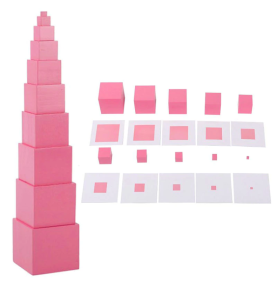
In the pink tower, only the size of the cubes changes: same colour, same material, same shape. The child can see clearly what they need to compare.

Control of error

A cylinder that will not go in, a tower that leans, a piece left over at the end: the material shows the mistake without an adult having to point it out.

From concrete to abstract

A quantity is held in the hand before it becomes a written numeral; a letter is traced with a finger before it is written in pencil.

Real objects, at the child’s size

A real little jug, a real sponge, tools that actually work: the child sees that their actions have a real effect.

One of each

In a classroom, each activity exists only once. The child learns to wait until it is free, and the material keeps its value.

Beautiful, complete, tidy

Well-made materials, with no missing pieces and always in the same place, make children want to pick them up and put them back in order.

Control of error deserves a closer look. Because the material itself signals what is wrong, the child does not need an adult to know whether they have succeeded. They correct themselves without feeling judged, and a mistake becomes a piece of information rather than a failure. This is also what allows the adult to stay in the background: they do not have to approve every single movement.

The five areas of the Montessori classroom for 3 to 6 year olds

In a classroom for 3 to 6 year olds, the materials are arranged by area, each on its own shelves. At home there is no question of reproducing all of it, but this division helps you spot what is missing and vary what you offer.

  • Practical life

    Pouring, transferring, buttoning, washing, sweeping, caring for plants. These everyday activities train coordination and concentration, and give the child an active place in the home.

  • Sensorial

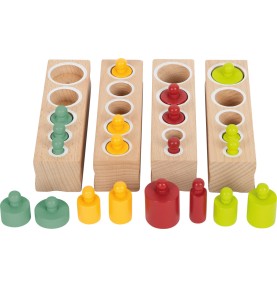
    Pink tower, brown stair, cylinder blocks, colour boxes, bells: each material isolates a single quality (size, colour, sound, weight) to sharpen perception.

  • Language

    Building vocabulary, sound games, sandpaper letters to touch, a moveable alphabet for making words: writing often comes before reading.

  • Mathematics

    Number rods, beads, spindles, boards: numbers and operations are handled before they are written down.

  • Culture

    Geography (globes, puzzle maps), science, botany, music and art: the world presented from the whole to the detail.

Beyond the age of 6, the same principle carries on: times tables, for example, are learnt with beads and boards that the child handles until the answers become obvious. Our mathematical toys follow the same logic, from first quantities to the first operations.

Examples

Six classic materials to see the method at work

Each one illustrates one of the principles described above. None of them is essential to get started: at home, plenty of activities can be done with everyday objects. More pieces are gathered in our Montessori materials range.

Once they can sit up One action, one visible result
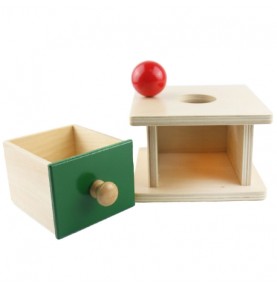
Wooden box with a round hole, a drawer and a red ball

Montessori Ball Box (object permanence)

The ball disappears through the hole and reappears in the drawer: the child checks for themselves that a hidden object still exists. The drawer can be taken out for the very first presentations.

From 18 months, with an adult One difficulty: size
Ten pink wooden cubes stacked from the largest to the smallest

The Montessori Pink Tower + Cards

Ten pink cubes of decreasing size to stack from the largest to the smallest. A cube in the wrong place shows straight away: the tower makes it obvious. The cards suggest other constructions.

From 2 and a half Refining the senses
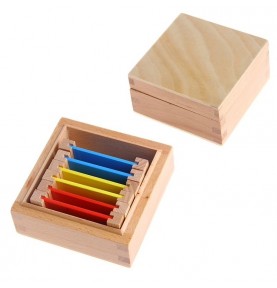
Wooden box holding six red, yellow and blue tablets

Colour Box - Small Size

Three pairs of tablets (red, yellow, blue) to match two by two. This is the first of the colour boxes: matching comes first, naming comes afterwards.

From 3 years Practical life and independence
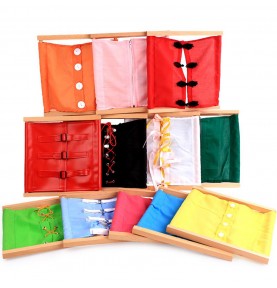
Wooden Montessori dressing frame, 25 x 25 cm

Montessori Dressing Frame

A 25 x 25 cm wooden frame that isolates a single fastening (buttons, poppers, laces or another, depending on the model), so the child can practise on a flat surface before trying on their own clothes.

Age by age

The Montessori method at each age

The principles stay the same, but the way they look in practice changes a great deal between a 4-month-old baby and a 5-year-old. Here is what characterises each stage, with the detailed guide to match.

0 to 12 months

Best baby toys from 0 to 12 months: the Montessori guide

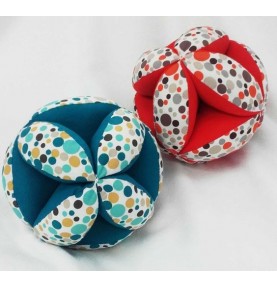
The first year is spent mostly on the floor: a firm mat, room to move freely, a low mirror, then objects to grasp. In the first weeks, the baby watches shapes and contrasts; the Montessori mobile, hung above them, feeds this need to look. Next come rattles, balls that are easy to catch and, towards the end of the year, the object permanence box.

6 to 12 years

What about after 6?

The child enters the second plane of development. They reason, imagine and become passionate about the big questions. Maria Montessori offered them a ‘cosmic education’: great stories about the universe, the Earth, life and human history, which then lead on to research in small groups.

At home

How can you apply the Montessori method at home?

Applying the Montessori method at home does not mean turning the living room into a classroom or buying every piece of material a school would have. The approach is first and foremost an attitude: letting the child do what they can do on their own, arranging the space so that they are able to, and observing them to know what to offer next. Four levers are enough to get started.

Arrange each room at their height

Get down to your child’s height: what can they reach, open and put away by themselves? The aim is to make the things they need easy to get to, and to put anything that could hurt them out of reach.

The bedroom

For a baby, a floor bed or a low bed lets them lie down and get up on their own once they are able to. Later on, a low shelf with a few activities, a basket of books displayed with their covers facing out and a mirror at their height.

The hallway

A low peg for their coat, a little bench to sit on and a tray for their shoes: they can get dressed and undressed without waiting for someone to help.

The kitchen

A stable step stool so they can see the worktop, a low drawer with their own crockery, a small jug they can lift: they take part in meals instead of just watching them being made.

The bathroom

A stool in front of the basin, their towel on a hook within reach, their toothbrush in a cup they can get to on their own.

On the shelf, less is more. Six to eight activities, each one complete and set out on a tray or in a basket, are worth more than an overflowing toy box. The others stay in a cupboard and come back in rotation, every one to three weeks depending on the child’s interest. An activity they no longer touch can be put away; one they keep coming back to stays out.

Involve your child in family life

Practical life activities are the heart of the approach at home, and they cost almost nothing. From 15 to 18 months, a child can put dirty clothes in a basket, carry their towel and wipe the table with a small sponge. At around 2 or 3, they can wash vegetables, pour their own water, lay the table, water a plant and fold napkins. At around 4 or 5, they peel, spread, slice a banana with a knife suited to their size and sort the washing by colour.

What matters is not the result, but the chance to carry out the whole task from beginning to end: fetching what is needed, doing it, cleaning up and putting everything away. Allow plenty of time, and give them tools at their size that really work.

A real-life example of the Montessori method: learning to pour

Here, step by step, is a real-life example of the Montessori method applied to an everyday movement. It usually suits children of around 2 to 2 and a half, when they can hold an object firmly in both hands and want to copy what the adults do at the table.

  1. 1

    Prepare

    On a tray with a raised edge, place two identical small jugs, one with a little water in the bottom, and a small sponge beside them. Use very little water at first: a mistake stays easy to put right.

  2. 2

    Show

    Sit down beside your child. Take hold of the handle, lift slowly, pour by tilting the jug without talking, then put it down. Do it again in the other direction.

  3. 3

    Let them try

    Invite them to have a go. If they spill, do not clean up for them: hand them the sponge. Wiping up is part of the activity.

  4. 4

    Let them repeat

    They may pour ten times in a row. That is a sign the activity suits them: do not interrupt, and do not comment on every attempt.

  5. 5

    Move on

    Once they succeed easily, increase the amount of water, then move to smaller containers, then a funnel, and finally the real glass they fill themselves at the table.

Everything is there: a real movement, an isolated difficulty, a slow and silent presentation, a visible mistake that the child puts right alone, the freedom to repeat, then progress based on observation. The same pattern works for buttoning, folding, screwing and unscrewing, or sorting.

Observe, then adjust

If your child empties every drawer in the house, they may be looking for ways to fill and empty things: offer them a basket of objects to transfer from one container to another. If they ignore their shelf, the activities may be too easy, too hard or simply too many.

What you do not need to do

There is no need to throw out their toys or to ban anything that is not ‘Montessori’. There is no need to aim for perfection either: a family is not a classroom, and every day comes with its own constraints. If you do choose a few objects, go for simple toys that let the child act rather than watch the toy act: that is the whole point of the solid wood or plastic question explored in our Montessori rainbow comparison, and the reason to prefer them to battery-powered toys. Our traditional wooden toys and our full range of Montessori toys are sorted by age to make that choice easier.

Comparison

Montessori, Freinet, Steiner-Waldorf: how they differ

Montessori education belongs to the family of so-called ‘active’ approaches, which emerged in the early twentieth century as a reaction against schooling built on passive listening. Two others are often mentioned alongside it: the approach of Célestin Freinet, widely known in France, and that of Rudolf Steiner, whose schools are known in the UK as Steiner-Waldorf schools. They share the conviction that children learn by doing, but they do not draw the same conclusions from it.

Comparison of the Montessori, Freinet and Steiner-Waldorf approaches
Criterion Montessori Freinet Steiner-Waldorf
Origin Maria Montessori, doctor, Rome, 1907 Célestin Freinet, primary school teacher, France, 1920s Rudolf Steiner, philosopher, Stuttgart, 1919
Central idea Children build themselves through their own activity, in an environment prepared for them Children learn through free expression, trial and error and cooperation Development in stages, nourished by imagination, the arts and the rhythm of the day
Typical tools Sensorial and teaching materials that show the mistake themselves School printing press, free writing, class newspaper, letters exchanged between schools Natural materials, simple toys with little detail, drawing, painting, music
Place of imagination Before 6, reality comes first: real tasks, realistic pictures A large place for personal expression: writing, drawings, investigations A very large place: fairy tales, free play, imitation
Organisation Mostly individual work, ages mixed across three years Class cooperative, class council, work plans Classes by age, often with the same teacher for several years
Reading and writing Often through writing first, when the child shows an interest Starting from the texts the children write themselves Formal learning comes later, at around 6 to 7

And compared with a mainstream school?

In a traditional classroom, all the pupils of the same age follow the same lesson at the same time, at the pace set by the teacher, and are then assessed with marks. The Montessori way of teaching works differently: each child moves forward at their own pace on activities they have chosen, the teacher presents the materials to one child at a time, and progress is followed through observation rather than through marks. Both aim at the same core learning; it is the route that differs.

Montessori and Pikler, for babies

For the first year, Montessori is often compared with the work of Emmi Pikler, the Hungarian paediatrician who in 1946 founded the residential nursery on Lóczy Street, in Budapest. Both insist on freedom of movement: you do not put a baby into a position they cannot get into by themselves, and you let them discover their own balance on the floor. Many parents draw on both approaches at once.

Myths

Common myths about Montessori education

More than a century after the first Casa dei Bambini, Montessori education is often reduced to a few shortcuts. Here are five of them, and what is really the case.

‘With Montessori, children just do whatever they like.’

Children choose their activity, but within a precise framework: they respect others, look after the materials and put away what they have used. Maria Montessori spoke of a freedom that grows alongside inner discipline, not of an absence of rules.

‘It is meant for gifted children, or for children who struggle.’

Maria Montessori began with children considered to have severe difficulties, then applied her approach to children from an ordinary district of Rome. It is meant for all children, each one moving forward at their own pace.

‘Wooden toys are all it takes to be Montessori.’

A toy is not Montessori because of what it is made of. What counts is that it isolates a difficulty, lets the child act and allows them to see their own mistake. A wooden toy loaded with colours and functions is as far from the idea as a battery-powered one.

‘Montessori bans play and imagination.’

Before 6, Maria Montessori preferred to offer children real activities rather than fantasy stories, because they first build an understanding of the world as it is. That rules out neither free play nor stories; after 6, imagination even becomes central to her approach.

‘The method makes children cleverer.’

No approach to education can promise that. Researchers compare pupils from Montessori classrooms with pupils from other schools, with encouraging results on some points, but those results depend a great deal on how the method is applied. Its aim lies elsewhere: helping each child develop independence and concentration at their own pace.

Questions

Frequently asked questions about the Montessori method

Short answers to the questions parents ask most often when they first discover this approach.

What is the Montessori method, in a few words?

For a short definition of Montessori: it is an approach to education created in the early twentieth century by Maria Montessori, an Italian doctor. It starts from the idea that children learn by doing. You prepare surroundings at their size, with materials that let them succeed on their own and see their own mistakes, and the adult observes them in order to offer the right activity at the right time, instead of imposing a programme.

Who invented the Montessori method?

Maria Montessori (1870-1952), one of the first women doctors in Italy. She first worked with children who had severe difficulties, drawing on the French doctors Jean Itard and Édouard Séguin, then opened the first Casa dei Bambini in Rome in 1907. She built her method from what she observed there, adapting the materials to the way the children responded.

From what age can you use the Montessori method?

From birth. For a baby, that means freedom of movement on the floor, a safe space to explore and a few simple objects to look at and then grasp. The approach then develops with the child: practical life from around 18 months to 3 years, then sensorial materials, language and maths between 3 and 6. It is never too late to adopt its principles.

Does my child need to go to a Montessori school to follow this approach?

No. Many families apply its principles at home, whether or not their child attends a Montessori nursery or school: furniture and objects at their height, joining in with everyday tasks, a small number of tidy activities, observing before stepping in. A school brings a full set of materials and trained teachers, but the spirit of the method starts at home.

Do I need to buy special materials?

Not necessarily. Many of the activities use everyday objects: jugs, sponges, baskets, clothes, kitchen utensils. A few pieces designed for the method, such as an object permanence box for a baby or a pink tower from around 2, are useful, provided you offer them when the child is ready and do not put out too many at once.

What if my child does not use the materials as intended?

As long as they are not putting themselves in danger or damaging anything, let them explore: if they stack the cylinders instead of fitting them into their holes, they may mostly want to build. Offer them an activity that meets that need, and present the original use again another day. If they throw or break the materials, put them away calmly, explaining that they will come back later.

Does the Montessori method suit every child?

It was designed for all children, and Maria Montessori first applied it to children with severe difficulties before extending it to others. Each child moves forward at their own pace. Some thrive on individual work, others need more support: it is the adult’s observation that makes it possible to adapt what is offered.

Why avoid rewards and punishments?

Maria Montessori noticed that children absorbed in their work were not interested in rewards: success itself was enough for them. A child who acts for a sticker or a compliment ends up acting for the adult. Instead, describe what they have done, restate the limits calmly and show the right movement again, which leaves room for both firmness and warmth.

Can you follow the Montessori method with children of different ages?

Yes, and that is exactly how Montessori classrooms are organised, with three ages mixed together. At home, older children show movements to younger ones, and the little ones watch the older ones. Simply keep any materials with small parts meant for the older child out of the youngest one’s reach, for example on a higher shelf or in another room.

How can I get started this week?

Choose just one thing: a low peg for their coat, a step stool in the kitchen, or a shelf where you leave only a few activities. Pair it with an everyday task they can do on their own, such as pouring their water or putting their clothes in the washing basket. Then spend a few minutes a day observing what absorbs them: that is what will tell you what to offer next.

The Montessori approach

Less noise, more focus.

Simple wooden toys that let children explore, try again and succeed on their own.

Learning with their hands

No sound effects or flashing lights: children feel the wood, sense its weight and refine each movement through real action.

Spotting their own mistakes

The material shows when something is not quite right, so children adjust on their own, without an adult stepping in.

No screens, no batteries

The child brings the toy to life, not the other way round. No overstimulation, just calm and lasting concentration.

Sensory learning & active play

Why choose natural wood?

Children learn by handling the real world. Here is why the Montessori method leaves noisy electronics aside in favour of natural materials.

1 Senses, touch & perception
Montessori wood

A warm, living material

The silky feel of sanded beech, a unique natural grain and a real weight in the hand that helps children remember through touch and movement.

Ordinary plastic

A cold, uniform surface

The same artificial texture everywhere, with little to feel or push against for a child learning through movement.

2 Independence & imagination
Montessori wood

The child leads the play

No set script: children explore, handle, learn from their own mistakes and let their imagination run free.

Ordinary plastic

Just pressing buttons

Flashing lights and recorded sounds turn the child into a spectator rather than an active explorer.

3 Health & safe materials
Montessori wood

Natural and non-toxic

Wood from sustainably managed forests and non-toxic water-based finishes, safe for little ones who explore with their mouths.

Ordinary plastic

Synthetic materials

Synthetic polymers, chemical additives and sealed electronic circuits that are hard to repair.

4 Calm & longevity
Montessori wood

Quiet focus, made to last

A calm setting that supports deep concentration, and sturdy toys made to be handed down to younger brothers, sisters and cousins.

Ordinary plastic

Noise & short lifespan

Sensory overload, quick wear and disposable batteries that need replacing again and again.

Meets CE & EN 71 standards Non-toxic water-based paints Wood from sustainable forests