Marie - Helene H.
Really lovely toy Très beau jouet
Translated from French
Trending searches
Shop by budget
1 tap to filterBy age group
Compact rail
No toys found
We couldn't find any toys matching this search. Try a broader keyword or a different budget filter.
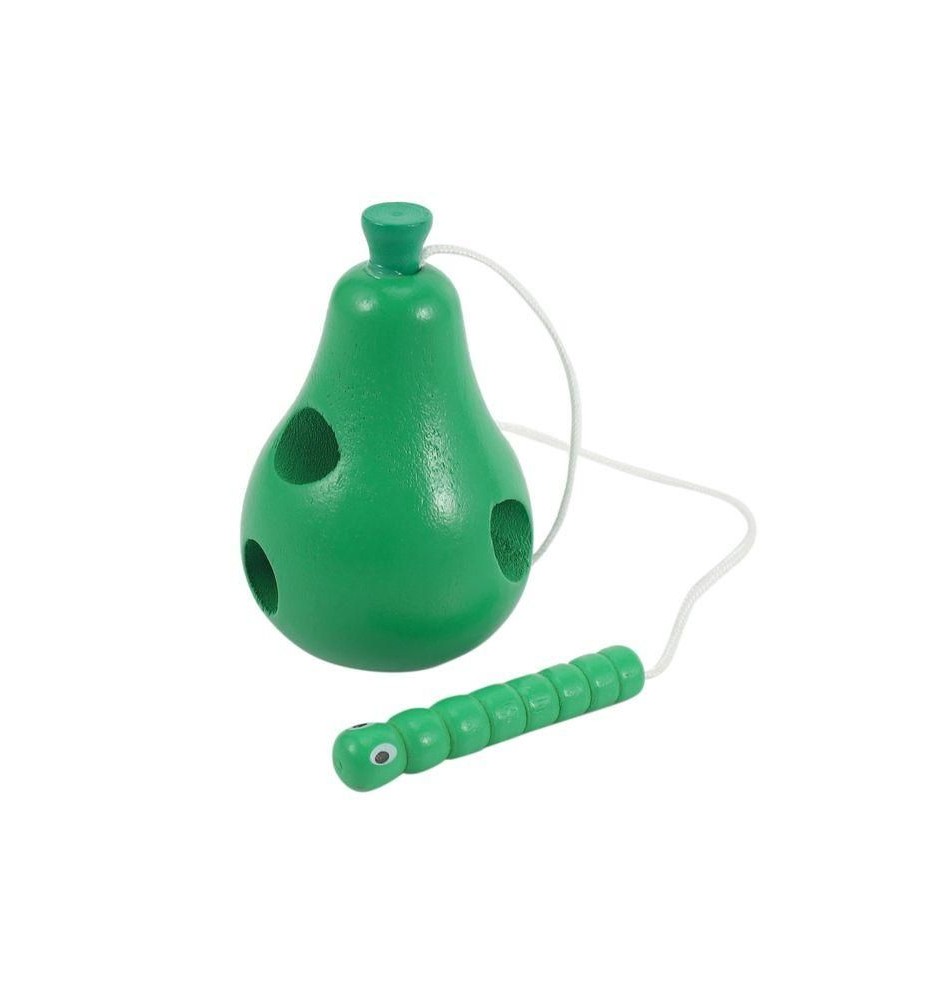
Browse all 600+ toys →Hole after hole, a little worm on a cord eats its way through this wooden pear lacing toy, small enough to hold in one hand. From 3 years, this Montessori-inspired game builds concentration, patience, coordination and fine motor skills, with a first lesson about fruit along the way.
Ref : REFVP014
The whole toy comes down to two pieces of wood joined by a cord. The pear stands 9 cm tall and measures 8.5 cm across, a size a three-year-old can steady with one hand while the other hand works. Holes run through it. At the end of the cord sits a small wooden worm that plays the part of the needle: stiff enough to push into a hole, and easy to catch when it comes out the other side.
At 250 g, the pear has enough weight to stay put on the table instead of skating away at the first push. That detail matters more than it seems: a child who has to chase the toy gives up on the lacing.
Picture the first try. Your child holds the pear, pokes the worm into a hole and then turns the fruit over and over, looking for the place where its head will appear. They pinch it, pull, and the cord follows. Then they look for the next hole. After a few passes the pear is wrapped in cord and the worm has nowhere left to go.
Undoing it is the second half of the game, and often the harder one, since the path has to be retraced backwards, one hole at a time. Once both directions are easy, change the rules:
The age comes from the cord. It needs to be long enough to wind round the pear several times, and a long cord is a strangulation hazard for a young child. This wooden pear lacing toy is therefore a table activity: taken out, played with while an adult is in the room, then put back on the shelf with the cord wound up. It is not a toy to leave in a cot, a pushchair or the back of the car.
Three is also the age when the game starts to make sense. A child of that age can hold a goal in mind for more than a few seconds, accept that a hole was the wrong one, and try again without throwing the pear across the room.
The worm is held between thumb and forefinger, the same pincer grip that will later hold a pencil. Aiming it at a hole asks the eyes and the hand to agree. Pulling the cord through without tangling it teaches that a job has steps, and that rushing one spoils the next.
These are the gestures behind sewing on a button, lacing a shoe and writing a first letter. None of them can be explained; they are learned by doing the same small movement many times. If your child enjoys this kind of work, our fine motor skills toys offer other gestures to practise: screwing, stacking, balancing.
The pear follows a principle found across wooden Montessori toys: one difficulty at a time. No colours to sort, no numbers to count, only a worm to pass through a hole. Because nothing distracts from that gesture, a child can repeat it until it becomes smooth.
The toy also corrects itself. Either the worm comes out or it does not; either the cord pulls free or it catches. Your child can see the result without anyone telling them, which is why we suggest showing the game once, slowly and without talking, then stepping back.
Among our threading toys, three share the same idea. The apple has a caterpillar, the cheese has a mouse, and the pear has its worm. The movement is the same on all three, so let the story decide: the one your child will want to tell is the one they will pick up again.
The pear has one extra use. Set it beside a real one from the fruit bowl and talk about what is the same and what is not: the shape, the stalk, where it grows, who else likes to eat it. To clean the wood, wipe it with a barely damp cloth and let it dry in the open air; never soak it.
From 3 years. Before that age the long cord is a hazard, and the game asks for more patience than most younger children have.
The pincer grip, hand-eye coordination, concentration and patience. It prepares the hand for sewing, tying shoelaces and holding a pencil.
It is Montessori-inspired: it isolates one gesture, and the child can check alone whether the worm has gone through.
The cord is long and carries a strangulation hazard warning. Keep the toy for children aged 3 and over, use it with an adult nearby and store it out of reach of younger brothers and sisters.
It is 9 cm tall and 8.5 cm in diameter, and weighs 250 g.
Warning: Long cord. Strangulation hazard. Please retain this information.
Toy safety information required prior to online purchase:
7 cm x Ø 4 cm
250 g
3+
Durable Natural Wood
CE & EN 71 certified, solvent-free non-toxic paints
Brand New (Original packaging)
Clean with a soft cloth lightly dampened with lukewarm water. Never submerge wood in water or use harsh detergents.
To preserve natural wood lustre over the years, apply a drop of vegetable oil or beeswax once a year.
This toy hasn't received an individual review yet. Here is certified feedback from families on our creations and service.
Really lovely toy Très beau jouet
Lovely toy, but the clown's head fits entirely into my grandson's mouth (12 months)… Which doesn't reassure me! Beau jouet mais la tête du clown rentre entièrement dans la bouche de mon petit fils (12mois) …. Ce qui ne me rassure pas !
Fast dispatch, products as described. Envoi rapide, produits conformes à la description.
Quick, efficient and great games! Rapide, efficace et jeux top!
Clever! Understood how to tell the time in no time at all, memory did the rest. Fun +++ Astucieux ! Compris l'heure en un rien de temps, la mémoire a fait le reste. Ludique +++
Brilliant! Génial !
Other sensory and developmental materials designed for this stage of growth.