Marie - Helene H.
Really lovely toy Très beau jouet
Translated from French
Trending searches
Shop by budget
1 tap to filterBy age group
Compact rail
No toys found
We couldn't find any toys matching this search. Try a broader keyword or a different budget filter.
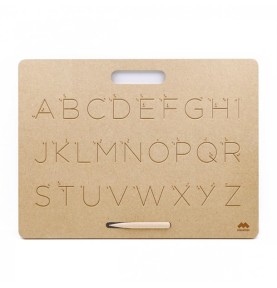
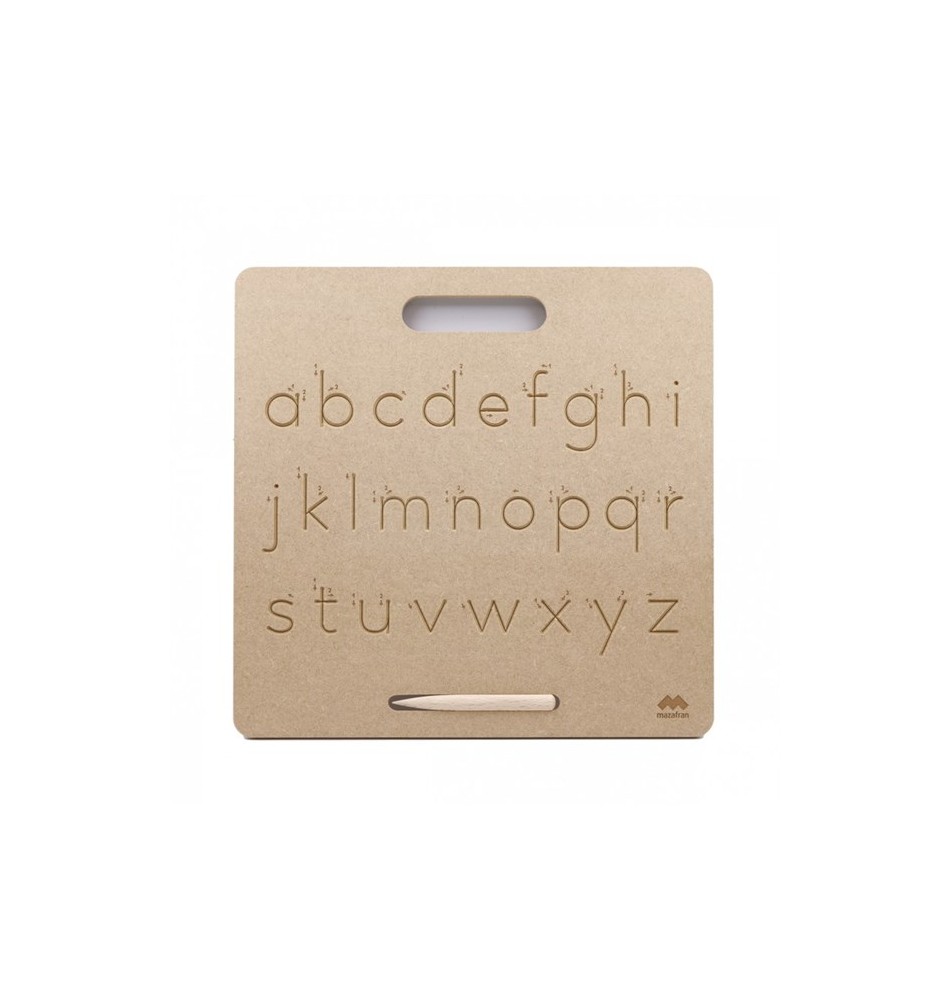
Browse all 600+ toys →A letter tracing board in wood, 39 x 29 cm, with the lowercase alphabet in print script for children aged 3 and up. Your child follows each letter with a fingertip, then with the 10 cm stylus, learning its shape and direction before pencil and paper. A calm first step among Montessori language materials.
Ref : REFMZ005
Picture the board flat on the kitchen table after breakfast. Your child picks a letter, perhaps the first one of their name, and runs a finger along it from start to finish. Then comes the stylus, held like a pencil, following the same path. Nothing to sharpen, nothing to rub out and no page to spoil: the letter can be traced ten times in a row and it is ready for an eleventh.
The board measures 39 x 29 cm and is 1 cm thick, so the letters are large enough for a small hand that is still learning to steer. At 250 g it is light enough for a three-year-old to carry to the table and put back on the shelf without help, and it rests just as well on a lap on the sofa.
Open any picture book and nearly every letter on the page is lowercase. Capitals appear only at the start of sentences and names, which is why many nurseries and Montessori settings begin with the small letters: they are the ones a child meets when starting to read.
Print script means each letter stands alone, in the same plain form found in books and on classroom walls. Cursive joins the letters with entry and exit strokes, which asks more of the hand. Capitals are built mostly from straight lines and are simpler to draw, but less useful for early reading. A lowercase print board therefore suits a child who is beginning to link sounds to letters and wants to write what they can read.
Three things, each tied to one movement:
Does tracing guarantee neat handwriting? No. It gives the hand a memory of each shape, and that makes the first attempts on paper far less frustrating.
If your child does not yet know the letter shapes at all, an inset board where each letter lifts out and fits back in is a gentler start. This board comes next, when the question is no longer "which letter is it?" but "how do I write it?".
One thing we would pass on to any parent: resist the urge to work through the alphabet from a to z. Choose two or three letters that look and sound very different, such as "s", "m" and "t", and stay with them for a few days.
Five minutes is plenty. Leave the board within reach on a low shelf and you will often find your child returning to it alone. Like other Montessori materials, it works best when it is always available and never imposed. It also sits comfortably beside the rest of our Montessori educational toys for the pre-school years.
This one is for ages 3 and up. Most children get the most from it between 3 and the start of school: first with a finger, then with the stylus, and finally as a model to copy on paper.
Lowercase is the usual starting point in Montessori settings, because almost all the text a child reads is in small letters. Capitals follow naturally once the lowercase shapes are familiar.
Lay it flat, choose one letter, trace it with a finger while saying its sound, then repeat with the stylus. One or two letters per sitting is enough.
Yes, the board comes with a 10 cm stylus. It is a small item, so store it with the board and out of reach of children under 3.
They help with letter formation: where each letter starts and which way the stroke travels. Regular practice on paper is still needed afterwards, but it starts from a movement the hand already knows.
Wipe the board with a soft, barely damp cloth and let it dry flat; wood does not like to be soaked.
Warning: Not suitable for children under 36 months. Small parts. Choking hazard. Retain this information.
Toy safety information required prior to online purchase:
Tablette : 39 x 29 x 1 cm / Stylet : 10 cm
0.25 kg
3+
Durable Natural Wood
CE & EN 71 certified, solvent-free non-toxic paints
Brand New (Original packaging)
Clean with a soft cloth lightly dampened with lukewarm water. Never submerge wood in water or use harsh detergents.
To preserve natural wood lustre over the years, apply a drop of vegetable oil or beeswax once a year.
This toy hasn't received an individual review yet. Here is certified feedback from families on our creations and service.
Really lovely toy Très beau jouet
Lovely toy, but the clown's head fits entirely into my grandson's mouth (12 months)… Which doesn't reassure me! Beau jouet mais la tête du clown rentre entièrement dans la bouche de mon petit fils (12mois) …. Ce qui ne me rassure pas !
Fast dispatch, products as described. Envoi rapide, produits conformes à la description.
Quick, efficient and great games! Rapide, efficace et jeux top!
Clever! Understood how to tell the time in no time at all, memory did the rest. Fun +++ Astucieux ! Compris l'heure en un rien de temps, la mémoire a fait le reste. Ludique +++
Brilliant! Génial !
Other sensory and developmental materials designed for this stage of growth.