
- New
Wooden Montessori Colour Sorting Game – 20 Animals, 2 Dice
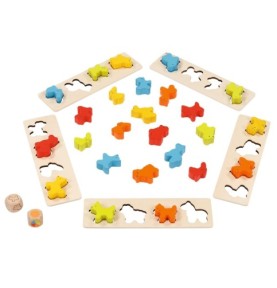
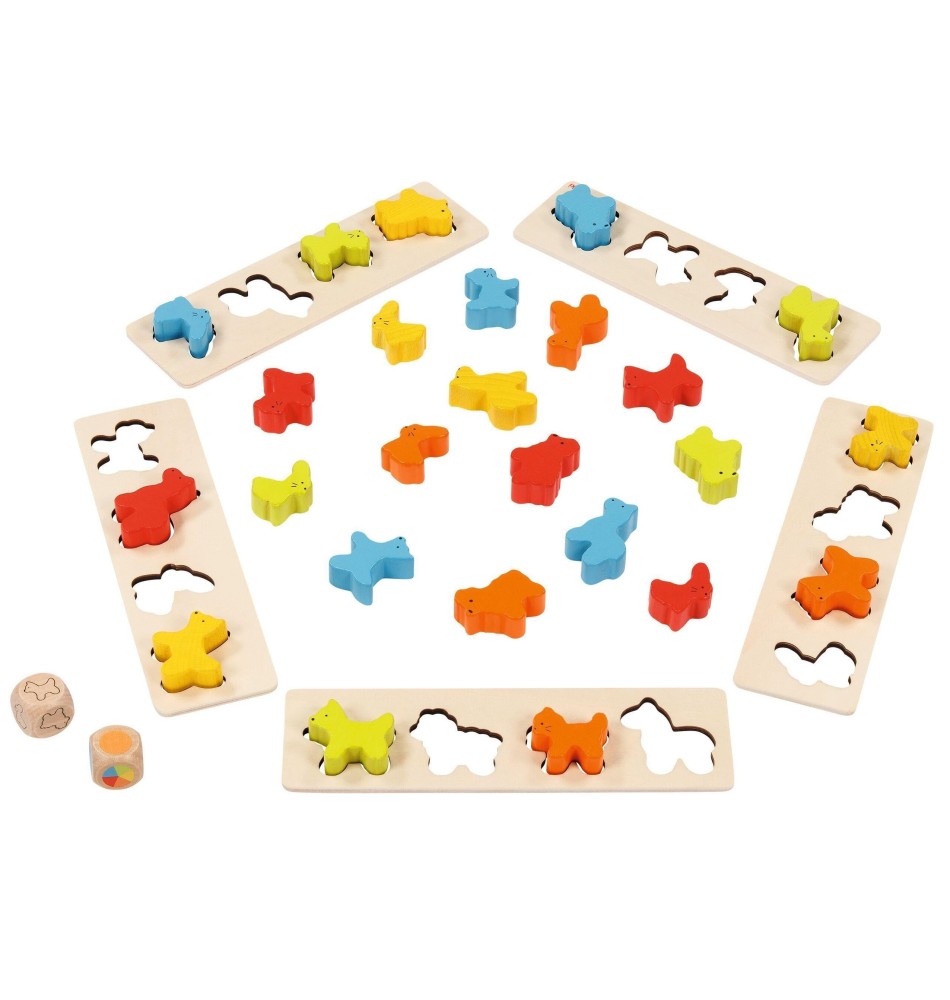
A colour sorting game for toddlers from 2 years: one dice names the animal, the other the colour, and your child fits that figure into its hole on a wooden board. Twenty animals in five colours make it both a sorting and matching game and a first board game.
Reference :
REFG56765
One dice for the animal, one for the colour
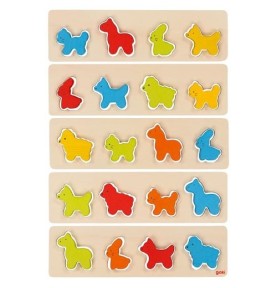
Each player takes a light wooden board with four holes, each cut to the outline of an animal. The twenty wooden animal figures wait in the middle of the table: four familiar animals, among them a cat, a rabbit and a sheep, each made in red, blue, yellow, green and orange. Your child rolls the two wooden dice. One shows an animal, the other a patch of colour. Now the hunt begins for the yellow sheep or the blue rabbit: your child picks it out of the pile and slides it into the hole that matches its shape. The first player to fill their board wins.
The whole colour sorting game comes down to that sequence: read two clues, bring them together in a single piece, then turn the piece until it drops flat into its place. The figures are thick and stand up on their own, so between games your child lines them up, groups them by colour or walks them across the table like any set of wooden animals.
Two clues in one piece, and a hand that has to be precise
The first skill at work is combining two criteria. To find the orange cat, your child has to set aside the green cat, but also the orange rabbit. Many colour sorting games ask for a single criterion; here the outline matters as much as the shade, which turns simple colour sorting into reasoning about shape and colour together. Saying out loud what the dice show, “the sheep… red”, puts words to the gesture. To work on shades alone, our colour sorting toys isolate that one difficulty.
The second is fine motor control. An animal outline only fits one way round: the figure has to be held between thumb and forefinger, turned, then the head and legs lined up with the edge of the hole. Repeated on every turn, this precise movement builds fine motor abilities without ever feeling like an exercise. The board also corrects the child by itself: if the piece will not go in, the shape is wrong, and no adult needs to point it out. In the Montessori approach, this principle is called control of error.
The first games: presenting it step by step
The first time, offer this colour sorting game without the dice. Put a single board in front of your child with the four animals of one colour, and let them work out which outline goes into which hole. When that gesture is secure, mix two colours, then more, and suggest sorting by colour: all the reds on one side, all the blues on the other. The most common mistake is tipping out all twenty pieces and both dice at the same time: too many clues together, and the game turns into unpacking.
When your child can sort by colour and recognises the four outlines, bring in the animal dice on its own, then add the colour dice. For a change, swap roles: you roll the dice and announce the result, and your child fetches the right figure without looking at the dice.
From fitting figures at 2 to a first game with rules
From 2 years, children fit the animals into the boards and stand them up; the rules come later. At this stage the colour sorting game sits naturally among animal toys for 2 year olds, because the figures are as much for handling as for the game. Then, with taking turns, waiting and losing a round now and then, it becomes a first board game, for two players or more. For other ideas at the same stage, have a look at our early learning toys.
At nursery, it works well for a small group around a table, with one board per child. Staff also get one of the clearest examples of fine motor work for this age, since every turn ends with a piece to fit by hand.
Boards, figures and dice are all wooden: wipe them with a barely damp cloth, let them dry in the open air and never leave them to soak. Put the twenty animals away together after each game, because one missing piece leaves a board that can never be completed.
How it differs from a simple inset board
A simple inset board offers one tray and its pieces, which the child fills and then empties again. Among matching games for toddlers, this one changes how the pieces are used: each player has their own board, the dice decide the order, and the same set works as a quiet sorting and matching game for one child or as a game for several. Without the dice, it joins the Montessori games for toddlers that a child repeats until the gesture is sure; with the dice, it becomes a shared game round the table.
Next to the usual animal toys for toddlers, these figures have a job to do: each one has its place on a board and a pair of dice that calls it. That makes it a good gift for 2 year olds who already love animals, since the figures can be played with long before the rules are. When your child is ready for longer rules, our board games take over.
Questions parents ask
What age is this colour sorting game for?
It is recommended from 2 years. Younger players start by fitting the animals without the dice; the full game with both dice and taking turns comes when your child recognises the outlines and the colours.
How do you play with the two dice?
Each player takes a board. On their turn, they roll the animal dice and the colour dice, pick up the matching figure and fit it into their board. The first to fill all four holes wins.
Can you play without the dice?
Yes. Without the dice, the boards and the twenty figures work as an inset and sorting set: grouping all the animals of one colour, completing a board, or standing the figures up to tell a story.
Which animals and colours are in the set?
Four familiar animals, including a cat, a rabbit and a sheep, each in five colours: red, blue, yellow, green and orange. That makes twenty figures for five boards of four holes.
What is in the set
- Recommended age: from 2 years
- Contents: 27 pieces – 5 playing boards with 4 holes each, 20 animal figures (4 animals in 5 colours) and 2 dice (1 animal dice, 1 colour dice)
- Material: wood
- Dimensions of one playing board: 24 x 7 cm
- Brand: Goki, reference 56765
- 2-year guarantee on all our products
Reference
REFG56765
Condition
New
Specific References
16 other products in the same category:
-
 Wooden Animal Memory...£17.99
 -
- New
Wooden table curling game...£32.99 -
- New
-
- New
Large Snakes and Ladders...£29.99 -
- New
-
- New
-
 Premium Wooden Rummikub...£34.99
 -
- Product available on request
-
 Shut the Box Traditional...£18.99
 -
 20 Classic Wooden Board...£82.99
 -
- New
A colour sorting game for toddlers from 2 years: one dice names the animal, the other the colour, and your child fits that figure into its hole on a wooden board. Twenty animals in five colours make it both a sorting and matching game and a first board game.
