
- New
Montessori Feely Bag Game – 18 Wooden Keys to Match
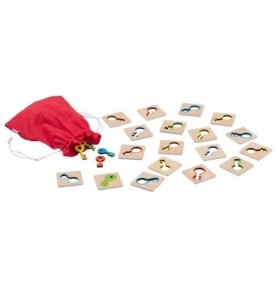
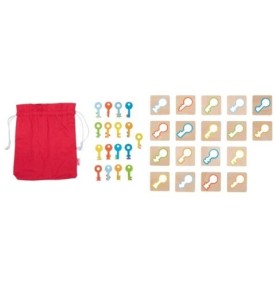
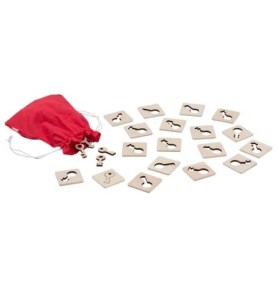
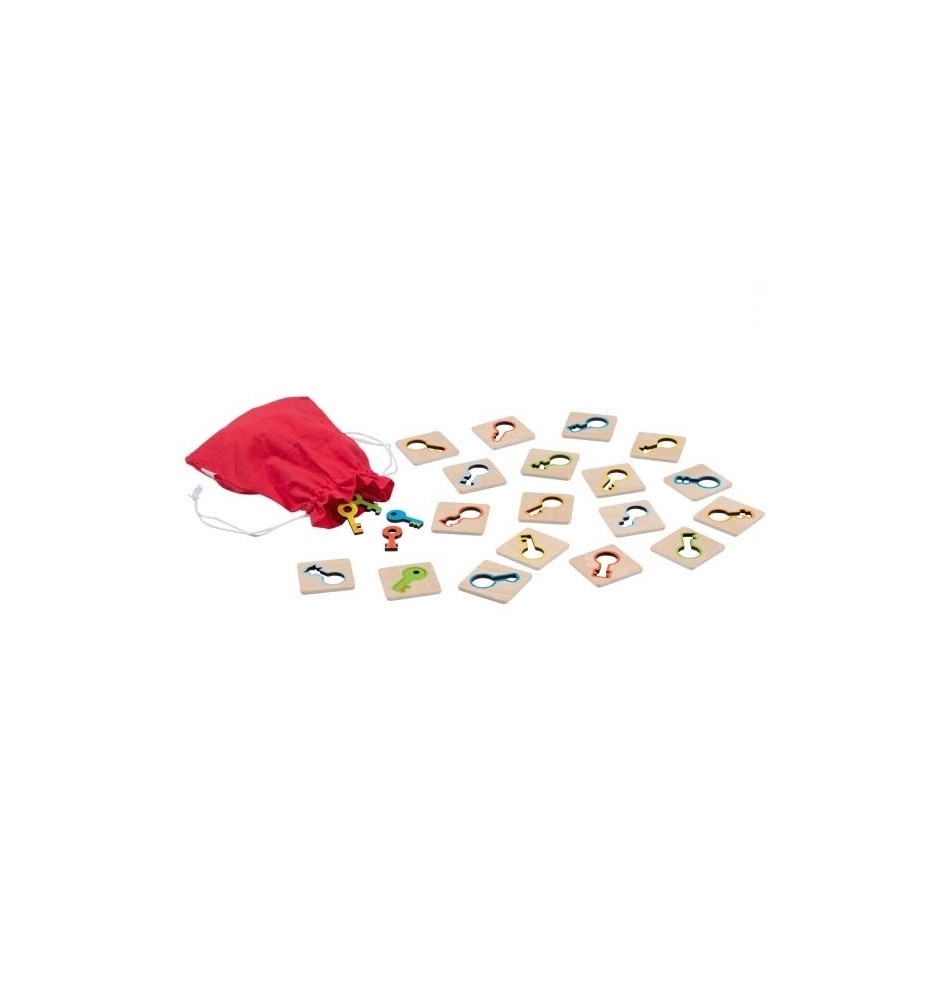
This feely bag game brings together 18 wooden keys and 18 boards with a key-shaped cut-out, and each key fits only one board. A coloured side to start, a plain side for later and a fabric bag for searching by touch: a Montessori sensory game with keys for children from 3 years.
Reference :
REFG56326
One key from the bag, one board to find on the table
Your child slips a hand into the fabric bag and pulls out a wooden key. They turn it over, then look closely at the bit, the toothed end that would go into a lock: a square notch here, two small cuts there, a pointed tip on another. Their eyes then travel across the boards laid out on the table, looking for the one cut-out that repeats that exact outline. When they find it, the key drops into place and the next one comes out of the bag.
The 18 keys look alike at first glance, and that is the whole point of this feely bag game. A quick look is not enough: the child has to compare before trying, and soon notices that a single notch makes the difference between two keys.
What the eyes, then the fingertips, learn to tell apart
Telling two almost identical keys apart trains visual discrimination: one notch more, a wider tooth, a slanted edge instead of a straight one. Later, when the child has to find the right key inside the bag without looking, the feely bag game becomes a sensory exercise for the hand. Fingers follow the outline, count the notches and recognise the shape before the eyes ever see it. This is one of the clearest benefits of tactile sensory play: the hand learns to read a shape that the eyes have already studied.
The board shows the child whether they are right. A wrong key simply will not sit in the cut-out, and nobody needs to step in and correct. The Montessori approach calls this the control of error, and when the game is played with eyes closed, a second principle joins it: one sense works while the others are set aside. Unlike most tactile toys, which offer soft or bumpy textures to explore, this set asks the fingers to recognise one precise shape among eighteen.
A first round that starts on the coloured side
The first time, lay out just a few boards with the coloured side facing up, and hand your child only the keys that belong to them. On this side the colour markings give a clue, as the manufacturer's rules point out, so the first matches come quickly and the child stays with the game.
The mistake to avoid is spreading all 18 boards plain side up from the start. Too much choice without a single clue discourages a child before the eye has learned to read the bit of a key. When the coloured side is easy, turn the boards over. After that comes the feely bag activity itself: the child names a board, then searches the bag with eyes closed for the key that fits it. In a nursery or a classroom, the set works well presented on a tray with the bag beside it, as a corner for one sense at a time.
From quiet matching to a race for the right board
From 3 years, your child simply matches each key to its board, at their own pace. The manufacturer's rule comes next: one key is drawn from the bag, and every player points as fast as they can to the board it fits. The feely bag game then turns into an observation race, and you can leave the coloured side to younger players while the more experienced ones play on the plain side. As a tactile sensory game for siblings of different ages, it adapts without changing the box.
A few tactile sensory play ideas that need nothing extra: hide three keys in the bag and ask for a particular one; take turns describing a key by touch alone while the other player guesses its board; or lay out only the boards whose keys look most alike.
For care, wipe the wood with a barely damp cloth and let it dry in the open air; do not soak it. Putting the keys back in the drawstring bag after each round makes it far less likely that one goes missing.
How it differs from a picture card memo
What is a feely bag, exactly? In early years settings it is a cloth bag hiding objects that children identify by touch, and many parents wonder what to put in a feely bag at home. Here the answer comes in the box: 18 keys that differ only by their bit, each with its own board. A classic card memo is played with pictures turned face down and works mainly on visual recall. This game with keys makes its pairs by shape instead, since the key has to fit its cut-out, which brings the hand into the observation.
Among Montessori games for the senses, it stands out because a single game covers sight, touch and a quick race for several players. To compare other ways of training the senses, our sensory games each work on one sense at a time, while our board games are chosen to be played together around a rule. For older children, more ideas are gathered among our toys for 5 and 6 year olds. And if you are collecting feely bag ideas for a classroom, this set brings a ready-made challenge with built-in levels.
Questions parents ask
What age is this feely bag game suitable for?
The manufacturer recommends it from 3 years. The keys are small parts, so it is not suitable for younger children.
How do you play with several children?
One key is drawn from the bag, and the quickest player points to the board it fits. To make it harder, turn the boards over to their plain side.
What is the plain side of the boards for?
Without colour markings there is no colour clue left: only the shape of the cut-out guides the child. It is the next step when the coloured side is mastered.
How should the wooden pieces be cleaned and stored?
The keys go back in the drawstring bag after each round. A barely damp cloth is enough for the wood.
Product details
- Age: from 3 years
- Contents: 18 wooden keys, 18 wooden boards each with a key-shaped cut-out (one coloured side, one natural side), 1 fabric drawstring bag, game instructions
- Dimensions: 5 x 5 x 0.3 cm (each board)
- Materials: wood; fabric bag
- Brand: Goki, reference 56326
- 2-year guarantee
Warning: Not suitable for children under 3 years. Contains small parts that could be swallowed. Choking hazard.
Reference
REFG56326
Condition
New
Specific References
15 other products in the same category:
-
 Montessori Sound Memory...£52.99
 -
 Montessori Sensory...£38.99
 -

 Gift option£2.99
 -
 Wooden Chinese Checkers...£12.99
 -
 Montessori Sensory Touch...£32.99
 -
 Montessori Locomotive...£37.99
 -
 Sensory Tactile Matching...£26.99
 -
 Auditory Sound Memory...£42.99
 -
 Tactile Weight Memory...£47.99
This feely bag game brings together 18 wooden keys and 18 boards with a key-shaped cut-out, and each key fits only one board. A coloured side to start, a plain side for later and a fabric bag for searching by touch: a Montessori sensory game with keys for children from 3 years.
