
- New
Happy Families Card Game – Pocket Animal Families of Four
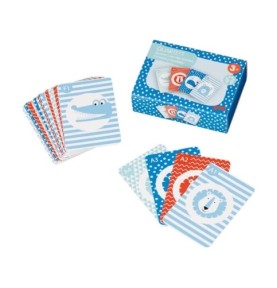
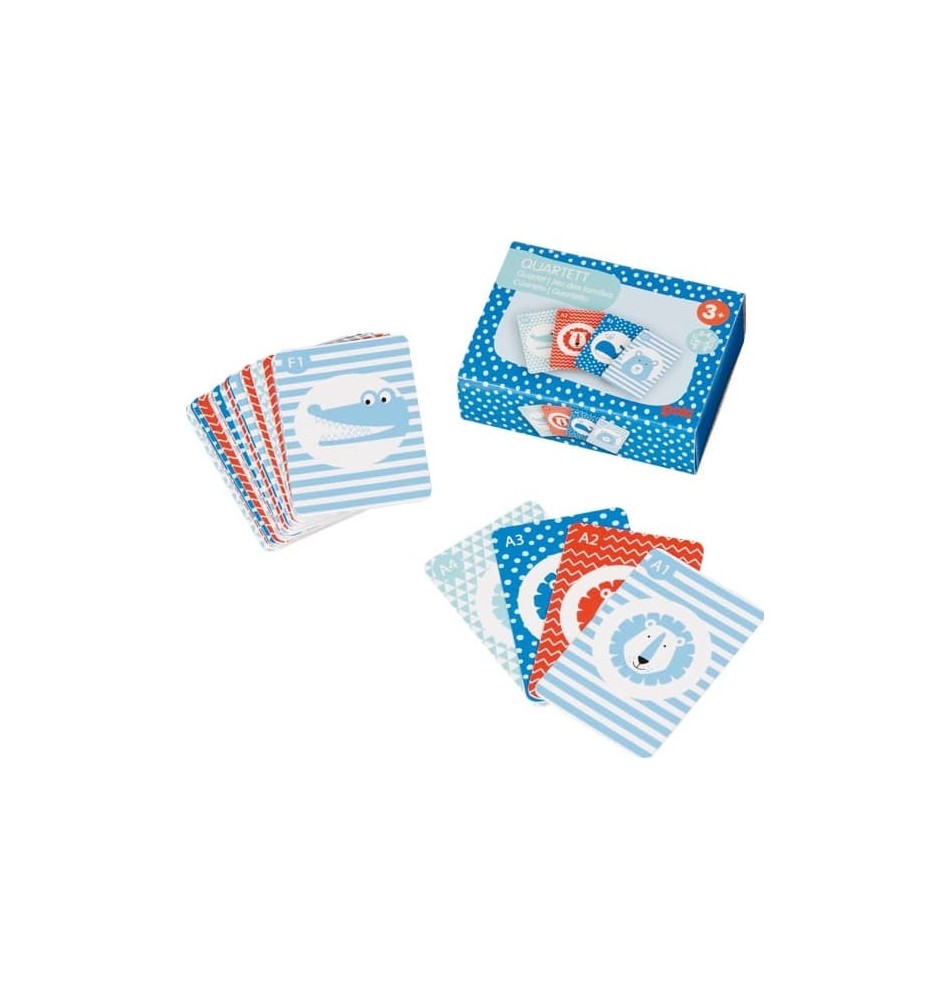
An animal Happy Families card game for children from 3 years, in quartet form: each family has four cards marked with a letter and a number. A Goki pocket box for 2 to 4 players, with simple, high-contrast drawings.
Reference :
REFG56755-2
Asking for the card your family is missing
Cards fanned out in one hand, your child looks at what is there, works out what is missing, turns to another player and asks: “Have you got Lion number 3, please?” If that player holds it, they hand it over and your child asks again. If not, the turn moves on. As soon as all four cards of one family are together, they go down on the table, and the player who has laid down the most families at the end wins.
This is the Happy Families card game that generations of British children have played, in its quartet form: every family is exactly four cards, so each one fills up quickly and a game stays short enough for a young child. Goki prints “Quartett” and “Jeu des familles” on the box, the German and French names of the same game. Some households deal out every card; others leave a pile in the middle and draw a card after an unsuccessful request. Both work with this pack, so agree on one before you start.
Animal families a child can read before reading
Each card has rounded corners and shows a stylised animal inside a white medallion. The four cards of one family repeat the same animal on four different backgrounds: pale blue stripes, white dots on royal blue, red zigzags, small pastel triangles. At the top, a letter and a number place each card in its family: A1, A2, A3 and A4 for the lion, F1 for the first crocodile. A bear and a whale are in the pack too.
Where the classic Happy Families card game characters are tradesmen and their relatives, the families here are animals, and that changes a lot for a child of 3. They do not need to read a name: they recognise the lion first, then gradually learn to look at the letter and the number in the corner. The clean, high-contrast drawings make a hand of cards easy to sort, even when it is held a little crookedly.
Sorting, asking, remembering: what each turn practises
As an educational card game, it works in three quiet steps. The first is sorting: arranging a hand by animal, then counting what is still missing from each family. The second is talking. To get a card, your child has to say clearly who they are asking and which card they want, wait for the answer, and take a “no” without giving up. Asking politely is part of the rule, not an extra lesson added on top.
The third step is memory. When a player asks for the whale and does not get it, everyone now knows that player holds a whale. A child who notices this knows whom to ask on the next turn. That is why parents often put it among the card games to improve memory at this age: remembering who asked for what is the whole strategy, and children discover it on their own after a few rounds.
A first game sized for a 3-year-old
Before the first real game, play with the cards face up. Spread the pack out, sort the cards together by animal, then build each family in number order, from 1 to 4. This is the easiest way to show how to play the Happy Families card game without long explanations: your child sees what a complete family looks like before ever having to ask for one.
Avoid starting with the whole pack in hidden hands. Holding many cards is hard for small hands, and a child who keeps dropping cards stops enjoying the game. A simple card holder, or a pile placed face down on the table in front of them, helps a lot. For the first proper game, keep only two or three families and two players.
Around 4, the game takes its usual shape: all the families, cards hidden, the polite request, and the rules of the Happy Families card game as most adults remember them. By then children start bluffing a little, asking for a family they do not collect just to see who answers, and the game becomes genuinely competitive.
A spotted blue box for coats, cafés and car journeys
The blue box with white dots fits in a coat pocket, which explains why it ends up among the travel games for kids that actually leave the house: at a café while waiting for food, on holiday, at the grandparents'. In the car it works best for a passenger with a tray table, since cards need a flat surface. Compared with many kids travel games, it has no small loose pieces apart from the cards themselves, and the rule needs no board.
It also sits well among family travel games, since adults and older siblings can join in without the game feeling babyish. Among games for travelling with a younger child, it has one advantage: the instructions for this Happy Families card game fit in a single sentence. If you are choosing travel games for 4 year olds, this is the age when it really takes off, and it is just as good as one of the travel games for 2 players for a parent and child on a long journey. Among the best travel games for kids at this age are the ones that are ready in seconds: here you open the box, deal, and the first question is asked.
The cards are cardboard. Play on a dry table, keep them away from snacks and drinks, and put them back in their box after every game: a single lost card means a family can never be completed.
Happy Families, Karemo or Black Bear?
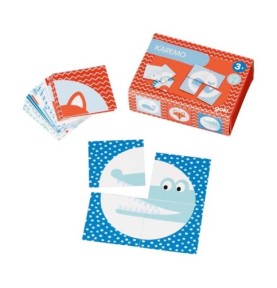
Goki makes three games in this same pocket format, all from 3 years. This animal Happy Families card game is the one that gets children talking: they ask, answer, refuse and negotiate. Karemo is played like a puzzle, rebuilding animal portraits from four quarters, with or without opponents, and makes a gentler start. Black Bear is an Old Maid style game: players form pairs of animals and try not to be left holding the bear.
For games with a board and counters, browse our board games. Our learning games gather other games built around sorting and memory, and children who love animals will find more in the Animal Kingdom collection.
Questions parents ask
How do you play Happy Families with a 3-year-old?
Start with the cards face up and only two or three families, and help your child phrase the request. Move on to hidden cards once they recognise every family without hesitating.
How many cards are there in each family?
Four, numbered 1 to 4 with the family's letter. Families fill up quickly, which keeps the game short.
How many players do you need?
The box shows 2 to 4 players. With two, the rule stays the same: each player asks the other in turn.
What is the difference between this and the other Goki mini card games?
Same box, same age, a different idea. Here you collect families by asking for cards, whereas Karemo rebuilds animals like a puzzle and Black Bear is about forming pairs.
Specifications
- Age: from 3 years
- Players: 2 to 4
- Contents: a pack of animal cards in families of four (codes A1 to A4, and so on)
- Material: cardboard (box and cards)
- Brand: Goki, reference 56755
- 2-year guarantee
Reference
REFG56755-2
Condition
New
Specific References
16 other products in the same category:
-
 Wooden Animal Memory...£17.99
 -
 20 Classic Wooden Board...£82.99
 -
- New
-
 Premium Wooden Rummikub...£34.99
 -
 Rainbow Wooden Tumbling...£29.99
 -
- New
Wooden Montessori Colour...£37.99 -
- New
Wooden Montessori Animal...£31.99 -
- Product available on request
-
- New
-
- Product available on request
Little Fishes Wooden Dice...£10.99
An animal Happy Families card game for children from 3 years, in quartet form: each family has four cards marked with a letter and a number. A Goki pocket box for 2 to 4 players, with simple, high-contrast drawings.
